

Monday, September 29, 2008
Sunday, September 28, 2008

"F" the bailouts! DON'T GIVE IN! Take back [y]our country!
A government bailout of the housing market is both fiscally and morally irresponsible; it is an unfair subsidy being paid to the wealthy bankers, the greedy mortgage brokers, flippers, and yes some homeowners, and the incautious, with little or no benefit to those paying the bill--taxpayers.
Why should responsible Americans be
forced to pay for the mistakes of others?
A bailout is morally irresponsible because it encourages reckless and irrational behavior.
- A bailout tells responsible Americans that they are suckers. If responsible Americans had been smart, they would NOT have overextended themselves, purchased homes they could not afford, and taken out home equity loans based on the paper value of their property.
- A bailout will force Americans who acted responsibly to pay for those who did not. The average American -- who saved and scrimped for years to buy a house, but could not because speculators and over-extenders boosted home prices beyond affordability -- will now be forced to pay for the homes of those who were less scrupulous.
- A bailout props up over-inflated housing prices, thereby putting homeownership out of reach for young families and responsible Americans who recognized that there was a bubble. The housing market needs the correction that the bailout seeks to prevent because the average American cannot afford to purchase a home. "You cannot be both in favor of affordable housing and in favor of propping up home prices!"
- A bailout creates perverse incentives. Rather than punishing their behavior, it encourages fiscal irresponsibility among bankers, mortgage brokers, speculators, and refinancers. These folks made money hand over fist in the past nine years (remember, homeborrowers who tapped their home equity received cash money to pay for Escalades, vacations, and stainless steel appliances; now they want you to pay for it!). Why change your behavior when you benefit from it?
- A bailout shifts the risks of falling market prices from financially secure banks to the American taxpayer. As a result, either taxes or the federal deficit will skyrocket! This is a government handout that we simply cannot afford and, moreover, it is wrong!
A bailout is contrary to the free market principles upon which our economy is based. It jams a huge wrench into the market correction, with negative effects that will be both severe and long-term.
It will truly be a sad day in America when our politicians vote to bail out the few from their irresponsibility to the detriment of the many who were responsible.
We, the American people, deserve better.
Stop the Housing Bailout!!!


Friday, September 26, 2008
A lesson from Luke: Do Not Conform!!!
Paul Leonard Newman (January 26, 1925 – September 26, 2008)


A true American!!!


Tuesday, September 23, 2008
...we do it everyday.
Brett Dennen - Ain't No Reason
There ain’t no reason things are this way.
Its how they always been and they intend to stay.
I can't explain why we live this way, we do it everyday.
Preachers on the podium speakin’ of saints in seance,
Prophets on the sidewalk beggin’ for change,
Old ladies laughing from the fire escape, cursing my name.
I got a basket full of lemons and they all taste the same,
A window and a pigeon with a broken wing,
You can spend your whole life workin’ for something
Just to have it taken away.
People walk around pushing back their debts,
Wearing pay checks like necklaces and bracelets,
Talking ‘bout nothing, not thinking ‘bout death,
Every little heartbeat, every little breath.
People walk a tight rope on a razors edge
Carrying their hurt and hatred and weapons.
It could be a bomb or a bullet or a pen
Or a thought or a word or a sentence.
There Ain't no reason things are this way.
It's how they always been and they intend to stay
I don’t know why I say the things I say, but I say them anyway.
But love will come set me free
Love will come set me free,I do believe
Love will come set me free, I know it will
Love will come set me free, yes.
Prison walls still standing tall,
Some things never change at all.
Keep on buildin’ prisons, gonna fill them all,
Keep on buildin’ bombs, gonna drop them all.
Working your fingers bear to the bone,
Breaking your back, make you sell your soul.
Like a lung that’s filled with coal, suffocatin’ slow.
The wind blows wild and I may move,
The politicians lie and I am not fooled.
You don't need no reason or a three piece suit to argue the truth.
The air on my skin and the world under my toes,
Slavery stitched into the fabric of my clothes,
Chaos and commotion wherever I go, love I try to follow.
Love will come set me free
Love will come set me free, I do believe
Love will come set me free, I know it will
Love will come set me free, yes.
There ain't no reason things are this way
It’s how they always been and they intend to stay
I can't explain why we live this way, we do it everyday.
Wednesday, September 17, 2008
Sunday, September 7, 2008
Wednesday, September 3, 2008
Sunday, August 31, 2008
Sunday, August 24, 2008
Sunday, August 17, 2008
The Ball Is In His Court
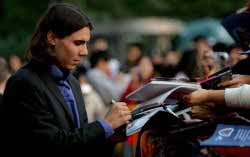 Rafael Nadal is enjoying his time at the Beijing Olympics--both on and off court. For the Spaniard, it's a welcome novelty to stay in the athletes' village--even if it means being stopped dozens of times in a day for autographs and photos with fellow competitors.
Tennis players rank at the top level of the pecking order in Olympic-land, and Nadal--who becomes ATP No.1 on Monday--is atop the heap. But the four-time French Open champion refuses to let his elite status go to his head.
"At the Olympic Village you have no driver at the door and no amazing room accommodations; who needs that to be happy?" he said. Getting back to the people has a good learning experience for the 20-year-old. "It really helps you see what real life is like."
The Swiss flag-bearer is having to stay in a hotel in the Chinese capital, because four years ago he was so inundated with requests for autographs and photos by fellow residents in the Olympic village in Athens that he found himself unable to eat a meal in the dining hall due to the constant interruptions.
Nadal, who insisted on being in the village with the rest of the Spanish team, found out about his new status almost as soon as his plane touched down in the Olympic city. He was surrounded by many other sporting superstars, but it was tennis' man of the moment who was mobbed.
Sunday, August 10, 2008


Sunday, August 3, 2008

Sunday, July 20, 2008
La Balle Au Mur

Journey
Have you ever seen a 77-year-old man do pushups?
“Here, it’s easy, you try it,” says grey-bearded Torben Ulrich as he flips a half-moon ball, balances the rubber on his carpet and thrusts away from the floor. “It’s a good feeling.”
Never mind that Ulrich played his last pro tennis match before resistance balls were invented. Here he is, prone on the bedroom floor of his upscale Seattle apartment, pistons pumping like a Marine.
But Ulrich is not tennis’ answer to Jack LaLanne; his home is the byproduct of a mind as busy as his body. Bookshelves cocoon every room, stacked high and wide with tomes like Women Mystics of Medieval Europe and Wit and its Relation to the Unconsciousness. An extravagant Buddhist shrine spans the sparse family room, adorned with 20 or so photos of teachers, tidy cups of rice and incense, and two statues of deities in mid-pose.
But what’s most striking are the bamboo ladders, in the foyer and bedroom. One narrows as it extends downward, the other closes in on its way up.
“We like to think of ourselves as living in the space in between,” Ulrich says about the home he shares with wife Molly Martin. “Where we can abstain from the ranking system—where one is better than another.”
In many ways, Ulrich has lived in that space his entire life. During his five decades on tour he beat the world’s best tennis players, set Davis Cup records and won a Wimbledon tournament. But to him the titles are almost accidental, consequences of a larger ideal. Younger generations recognize him as the father of Metallica drummer Lars Ulrich, but tennis fans know his persona ventures from athlete to musician, painter, poet, filmmaker, novelist, journalist. As we sit down, he opens two biographies published in his native Denmark. In one, a photo shows him stark naked in front of a tent at a spiritual retreat in Saanen, Switzerland. In the other, he’s getting hauled off a court in Calcutta after collapsing mid-match.
As a child in Copenhagen, Torben Ulrich excelled in speed skating, soccer and handball, but “my very earliest years were around the tennis court,” he says. He, brother Jorgen and father Einer formed the royal family of Danish tennis, playing 228 Davis Cup matches among them. To this day, Torben holds the Danish record for most ties (40) and years played (20).
In the ’50s and ’60s, Ulrich won a dozen Danish championships and took home titles around the world, including the French Indoor Championships and the Asian Championships in Lahore, Pakistan. “He plays a game within a game according to the rules he alone understands, to a tune he alone is hearing,” wrote Sports Illustrated in 1969. “He becomes a part of the game, not a disruptive part, but a part almost like the ball, moving as gracefully, as predictably as the movements of a piece of music.”
Ulrich’s focus showed on the Grand Masters tour; today he prefers to mug for the camera at Seattle’s Pike Place Market.

Music, it turns out, is the perfect analogy. From the very beginning, Ulrich’s racquet wasn’t his only instrument. He cherished his clarinet just as much, if not more. In 1952 Ulrich and friends opened the Blue Note, a club that gave him the chance to share the stage with greats like Louis Armstrong, Stan Getz and Dexter Gordon (Lars’ godfather) as they passed through Copenhagen. Not surprisingly, smoky jazz bars and singles matches weren’t always a harmonious combination. “Sometimes I couldn’t even get up for air,” Ulrich says.
In his halcyon youth, Ulrich would play at the Blue Note until about 1 a.m., head off to the office of the Danish newspaper Politiken for food, write a jazz column, then hit a café. “I’d meet up with friends who were still up, and then we’d have some beers and some breakfast, and sometimes sit there until 11 or 12,” he says. Noon meant band rehearsal, and then it was off to practice with the Davis Cup team at 4. When that wound down, it was time for another show at the Blue Note. “And all of a sudden, there were three or four days where I hadn’t slept,” he says. “But you can see how if you got into that cycle, and if you saw a lady or two in between, there was a lot of stuff going on.” More than once, it became too much.
“I had the taxi guy take me to the hospital, and I’d sort of lay low there for a couple of days,” he recalls thoughtfully.
The tennis circuit pulled just as hard, whether it was exploring Marrakech in a tournament car or gallivanting through Egypt with Gussie Moran, the sport’s first female sex symbol. “He made it to the top of the world of tennis without having to dedicate himself 24/7 just to tennis,” says fellow pro Jim McManus. “And I think that’s the remarkable thing about Torben; his 24/7 included so many other things that it would fill 10 lifetimes of most normal people.”
But even the most steely-eyed explorer can’t keep such a schedule forever. At 45, Ulrich was invited to join the famed Grand Masters circuit, which featured champions who could still swing a mean stroke, like Pancho Gonzales and Frank Sedgman. (Rod Laver and Ken Rosewall joined later.) “It wasn’t until the Grand Masters that [tennis] was more of a singularity,” Ulrich says. And then the true athlete bloomed, claiming the No. 1 world ranking on the circuit in 1976, and taking the Wimbledon Centennial senior doubles title with Sven Davidson.

..............................

 Before Metallica, Lars Ulrich was a ranked juniors player in Denmark.
..............................

But even at his career apex, Ulrich maintains that he was never interested in the outcome. “I know what the score is, but it doesn’t mean I’m attached to it,” says the devout Buddhist. “To me, the competition part of it, the score, was never of such importance. All of this was more of being open to a larger adventure, if you will, in terms of coming to a place and being open to what can happen, what you can learn.”
Stories of Ulrich’s spirit have filled books and locker rooms around the world. To kill time between practice sessions at Wimbledon, he would venture to a bank of phone booths under Centre Court and practice a saxophone down the line. (“I could play around seven minutes in one booth, and then I couldn’t breathe any more,” he says. “It would be too moist and soggy.”) He performed muscle experiments, like opening a door for half an hour or pushing a ball around a court with his nose. Following an old Tibetan practice, he spent three months trekking across Denmark by laying on the ground, standing, moving three feet, laying back down and repeating—for 90 miles.
Outside of his apartment, Ulrich acts his age. He takes my arm as we inch through Seattle’s Pike Place Market, past stalls hosing down and folding up for the night. We stop at a spot where young men hurl salmon from counter to counter to the delight of a few remaining tourists. “Hey, Mr. T!” shouts a fish flinger. They embrace, and make plans to play music later in the week. “This guy is a book of stories,” he says to me as Ulrich beams.
At 77, Ulrich is just as busy as he once was and ever will be. He recently finished a book of poems (or “lines”) called Terninger, tonefald, and crafted an essay on Sigmund Freud for a Danish book commemorating Freud’s 150th birthday. When the mood strikes he will wrap a studio in visqueen and slap ink-soaked jump ropes on rice paper, then “seal” the work with an inked tennis ball and poetry. He’s working on a sequel to his 2002 film, Before the Wall: Body & Being, an analysis of breath and awareness, whose soundtrack consists entirely of modulations of the smack of a Lars forehand. He vocalizes for an experimental Seattle band, However, with an “aspiration to dwell on sound itself as it unfolds in a fragile balance of line and pulse.”
And he still finds time for tennis. Every so often Ulrich’s neighbors will pull into their underground parking garage to find a lean, bearded man wearing a backwards hat and nailing forehands and backhands off the concrete walls. He does it as much for the exercise as to explore the sounds that reverberate off every corner.
But exploration takes many forms. Up in the living room, Ulrich takes a flute from a case, puts it to his lips and blows. But there’s no note—just a faint, flitty wind sound. “I’m trying to play a tone on the flute that is not there, so you only hear the overtones, where the flute kind of breaks,” he says. “The interplay of what you don’t see is what I’m interested in. “To me, the space in between is very important. The rhythm of that possibility, but also the breathing of that rhythm, if you will. The breathing of possibility.”
Torben Ulrich won a dozen championships in the '50s and '60s; An Ulrich original.
"Journey of a Lifetime", by Matt Williams, Deuce Magazine, June 2006 -- [http://www.deucemagazine.com/]
Torben's Art
...using tennis racquets and balls and also skipping rope with paint.
 Makes excellent Wallpaper!
La Balle Au Mur

"The Ball and The Wall"
("La Balle Au Mur")
For many ballplayers, across the various fields, having a wall as a practice partner was a training tool almost taken for granted. Over the years, however (with the advent of ball machines, etc.), the wall as a place of practice seemed to go out of fashion, if not become almost obsolete. Gil de Kermadec of the French Tennis Federation, director of an exemplary series of films on tennis (McEnroe, Borg, Evert, Connors), here sets out with Torben Ulrich in a two-fold approach, asking many past champions (Lacoste, Laver, Navratilova, Rosewall, Nastase) about their experiences with the wall, as well as looking into a variety of techniques that could extend the possibilities for practice and play.
Directed by Gil de Kermadec and T.U., 1988. 45 minutes
Note: Recent attempts by e-mail to inquire about purchasing this or other films/videos have not received a response.

After Work: Unusual post-tennis careers
http://www.tennis.com/features/general/features.aspx?id=100126
By Dan Weil
Photos by Getty Images/Hulton Archives
Pro tennis players, emerging from all corners of the globe and all different kinds of backgrounds, are an engaging bunch. Playing an individual sport, many of them march to the beat of their own drums.So it’s probably not a huge surprise that after their playing days are over, many former pros end up in jobs a bit less conventional than a middle-management position at a major corporation.Some, of course, stay closely connected to tennis. John McEnroe, Patrick McEnroe, Pam Shriver, Cliff Drysdale and Mary Joe Fernandez, among others, have had years of success as TV commentators. Others have taken up coaching, like Tony Roche, Brad Gilbert and now Jimmy Connors. Jim Courier has revived the senior tour in the U.S. with the Outback Champions Series.But others have gone far afield from their playing days. Here are a few of the most interesting career choices.

Andrea Jaeger — This two-time Grand Slam finalist, now 41, seemed to cultivate the ultimate teen-brat image during her heyday in the early 1980s. Perhaps she was just misunderstood. After injuries forced an early retirement, Jaeger used the money she made from tennis to start the Little Star Foundation in 1990. The group provides all kinds of support to children suffering from disease and poverty, including trips to a ranch in Aspen for the kids to have a week of fun. Jaeger has drawn the support of John McEnroe, Little Star’s first donor; Andre Agassi; and Pete Sampras too. And if that wasn’t virtuous enough, last September, Jaeger became an Anglican Dominican nun.

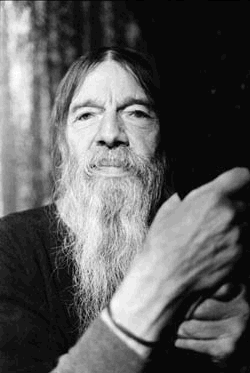
Torben Ulrich— Tennis has had a few renaissance men and women, none more so than the 77-year-old Dane who played Davis Cup for 20 years. He answers to writer, artist, musician and filmmaker. He also is father of Metallica drummer Lars Ulrich. Torben once created Jackson Pollock-like art by dipping tennis balls in paint and then pelting them against a canvas. His writing ranges from books of poetry to commentary on Sigmund Freud. During his playing days, Ulrich opened a jazz club in Copenhagen and played saxophone for seven minutes in a phone booth under Wimbledon’s Centre Court – until he couldn’t breath anymore. Now he can spend hours blowing into a flute, searching for a new tone.

Roscoe Tanner— He won the Australian Open in 1977 and was Wimbledon runner-up in 1979. But since retiring from the tour in 1985, life has snowballed downhill for the 55-year-old former Stanford star. He has been married three times, impregnated a woman from an escort service, bounced a check to buy a boat, used the boat as collateral for a loan and spent 10 months at prisons in Germany and the U.S. for unpaid child support and debt. The tennis court has been no sanctuary for Tanner. He has been arrested twice while playing
The Journeyman On Torben Ulrich
This week, I’d like to talk about one of the most eccentric professional tennis players ever. Torben Ulrich, from Copenhagen, Denmark, was a long-haired, bearded Charles Manson lookalike who competed from the 1940s to the 1970s. He won many singles titles and played in numerous Davis Cup matches for Denmark. He was one of the founding members of the ATP Tour in 1972.
He was a mainstay on the tour in the 1960s, but never won a Grand Slam title. He was prolific in many endeavors, including filmmaking, radio, paintings, and a music career. He would schedule practice courts at Wimbledon at dusk and instead of having a knock up with a player, he would sit cross-legged at the corner of the service box in the middle of the court and meditate to soak up positive energy with the hope that it would carry over into his match the next day.
In the 1950s, he would write reviews for the Daily Paper Politiken in Copenhagen about jazz music. He penned a book titled “Jazz, bold and buddhisme,” an anthology of his writings from the 1940s to 2000, published by Informations Forlag.
His most famous creative product was probably the film he co-directed with Frenchman Gil de Kermadec called “The Ball and the Wall,” about the importance of hitting against the wall in tennis. The film includes numerous interviews with former champions and footage of him hitting a ball against many walls around the globe.
Ulrich also dabbled in painting. He would make imprints with ink and acrylic on rice paper and use tennis racquets and balls and also skipping rope with paint on it as his instruments. He also was a radio correspondent in the US while on the road playing tennis. He would host the show and relay new jazz music from around the world to Danish radio. His son Lars, is currently the drummer for the rock band Metallica.
Lastly, Ulrich was a deep thinker. Upon the coin toss in a match against Tony Roche once at Wimbledon, Roche spun his racket and asked Ulrich to pick the up or down sign on his racket. Ulrich replied before the toss, “I like watching your service motion, it’s so elegant, why don’t you serve first Tony?”


Wednesday, July 2, 2008

Sunday, June 22, 2008

Sunday, June 15, 2008
You can fool some of the people all of the time...
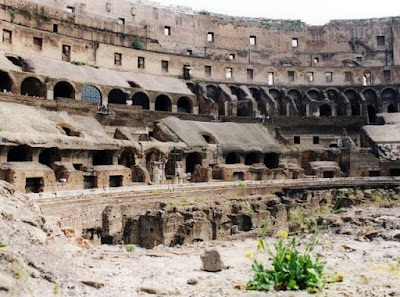
The Colosseum or Coliseum, originally the Flavian Amphitheater
(Latin: Amphitheatrum Flavium, Italian Anfiteatro Flavio or Colosseo)
An elliptical amphitheater in the center of the city of Rome, Italy.
...the largest ever built in the Roman Empire.
It is one of the greatest works of Roman architecture and Roman (social) engineering.
It is one of the greatest works of Roman architecture and Roman (social) engineering.
 The new Yankee Stadium under construction.
Taking a closer look at the Colosseum you realize what a magnificent arena this must have been.
Stand at ground level you can look up at the remains of the most complete side of the structure.
The stands seem so much steeper than modern stadiums, almost vertical, and when full, it must have felt like the crowd would fall on top of you.
It was here that for the first time, sport was widely used as a form of mass entertainment.
The ancient Roman sports may have been very different from the codified spectacles we watch today, but many factors that permeated sport then, still hold true today.
The gladiatorial contests and chariot races that took place were used to occupy the masses, distracting them from what was really happening.
To put on good games was, in a sense, a sign of respect for the people, and a way of winning their trust and affection--a valuable political resource for the future.
As the value of the games as springboards to political success became more and more apparent, competition between public figures to woo the people through spectacle, escalated--leading to ever more lavish and innovative presentations.
This trend delighted many, but also alarmed many. The importance of positions which provided unparalleled opportunities for advancing one’s political career by allowing one to stage the games, led to frequent cases of bribery, as candidates competed fiercely to attain these posts.
The fact that bribery to gain office was a capital offense was only a slight deterrent.
More than this, many clear-thinking Romans came to see the games, themselves, as forms of bribery.
Although the games were, obviously, not considered to be bribery in any strictly legal sense, their impact and use by ambitious politicians could not be discounted by citizens concerned about the future of their democracy.
The growth of the games in Rome was, therefore, not uncontested: philosophers and legislators frequently sought to limit their effect, to prevent them from distorting the political system and from "corrupting the morals of the people."
Moved by these concerns, the government experimented with placing spending caps on the games, as public officials frequently supplemented state funds, with private funds (drawn from their own fortunes, or raised from their political associates), in order to be able to put on ever more spectacular shows.
The clear intent was to prevent individuals from "buying elections" by means of the games.
Along similar lines, there were sometimes efforts to limit the number of gladiators that wealthy sponsors could present. In 65 BC, for example, the massive gladiatorial spectacle that Caesar originally planned was downsized by other politicians.
Although the principal justification was based on security--for the fierce revolt of Spartacus was still on the people’s mind, and the presence of so many well-trained, well-armed gladiator-slaves in the city seemed rather frightening--there was certainly also the motive, brought into play by Caesar’s political opponents, of stunting one avenue by which their rival might gain in political stature.
Interestingly enough, while the gladiatorial games generated some criticism on the basis of their "wasteful extravagance"; their political impact; and the occasional appearance of a free Roman citizen (lowering himself to the level of a criminal or slave in order to obtain glory as a gladiator, at the price of demeaning his class), few humanitarian objections were raised.
Those who lifted their voices against the games on account of their cruelty and brutality appear to have been a rather ineffective minority.
Laws prohibiting Roman nobles of the senatorial and equestrian orders from participating in the games as gladiators, charioteers, and actors were in effect (but they were also frequently violated).
The ruling class feared to present itself on the same level as those it had conquered and enslaved, for these spectacles could show all who watched, the vulnerability of those who sat on top of the social order.
(Long before: Alexander the Great, king of Macedon, was encouraged by his friends to participate in the Olympic Games. They were impressed by his great speed, but he discerned the risk of exposing his mystique and competing against ‘the common man’; and, therefore, is reputed to have said "he would do so only if he might have kings to run with him." Perhaps this spirit is what motivated the Roman legislation.)
Additionally, there were frequent efforts to ban certain components of "the games" in order to prevent the populace from being "corrupted", and the values believed responsible for upholding the greatness of Rome from being undermined.
The theater was a common target of such legislation. In 151 BC a large stone theater nearing completion was, in fact, ordered demolished by the Senate which heeded P. Scipio Nasica’s warning that it was "useless and injurious to public morals."
The content of many of the performances was deemed immoral; lewd; disrespectful; and valueless; there were frequent moments of conflict and discord as factions supporting rival performers clashed; or "rabble-rousers" and protesters descended on the theater to push their political agendas; or as themes or performances seemed to be critical of the ruling class. At various times in Roman history, certain kinds of performances were outlawed, and performers were even banished or executed.
In spite of these dynamics of resistance, however, the Roman games only grew stronger as time went on. In democratic Republican times, the public figures who opposed or limited them lost valuable political capital, and most often ended up sabotaging their political careers, exposing themselves to defeat in the next election; in Imperial times, the Emperors recognized the crucial social value of the games as outlets for the masses to let off their steam without threatening the system; as distractions of critical importance, and allies in their own survival.
To truly understand the games--before continuing on to the always fascinating, always shocking details of the spectacles--it is necessary to take a closer look at the social history of Rome. It is in this history--in the tense and unresolved relations between the classes--that the true meaning, and perhaps the greatest damage of the games, will be found…
Romans, upon liberating themselves, instituted a new political system, transforming themselves into a Republic (a nation governed by its citizens through their elected representatives).
This withdrawal from kings, after a period of bitter abuse by kings, is reminiscent of the American Revolution and the birth of our own democracy. What is also common between the Roman and American experiences is the limited nature of the original democracy which replaced the kings who had provoked the liberating reaction. Democracy, as it first appeared in Rome, was for the wealthy and the powerful. They wanted freedom from others like themselves, not for others to be free from them.
Ultimately, Rome fell because its rich and poor could never bridge the gap between them; and in the tragedy of its demise, the Games played a major role.
Rome gave in to a system designed to placate everyone, without solving anything. Shallow answers were chosen over deep ones, because deep ones were no longer possible without terrible pain; and it is always easier to send one’s pain into the future--to let others suffer for what one has left undone. In a nutshell, the solution to Rome’s social crisis was one in which the rich would continue to dominate, and the poor, in between social bright spots, would continue to lose their land, and struggle to find employment. No adequate plans or social measures would be put into place to prevent poverty from existing or expanding; rather, the social volatility of poverty would be neutralized by the safety net of the dole--free grain, or "bread"--to be distributed, at state expense, to the poor; and by the presentation of ever more spectacular games and entertainments, meant to distract those who might otherwise have rebelled, to channel anger into the passion of spectatorship, and to hide the wounds of injustice which cut into the lives of the poor beneath the wounds of gladiators, dying for them, as they were dying for the rich.
The Colosseum provided vastly improved settings for the enjoyment of the spectacles, its magnificence provided an illusion of opulence, a kind of part-time wealth, for the poor, the out-of-work, the oppressed, the overcrowded, the miserable and the powerless.
To maintain this system, wealth from outside of the system needed to be brought in, which implied conquest, followed by occupation, tribute, and taxation. But to seize and control this external wealth, which was used to buy off the revolution that the system would otherwise have created through its unremedied faults, also required huge expenses--for the maintenance of gigantic armies, positioned throughout the entire ancient world, was no simple matter.
Tax increases were the logical, if deadly response: tax increases to pay for the grain, the games, the armies.
But of course these taxes only broke the back of the remaining productive sectors, creating even more proletarians, who ended up in Rome, dependent upon free bread, and the pacifying mechanism of the games.
And thus the economic vibrancy and human strength of the Empire began to rot away, as men who might have been virile farmers and citizen-soldiers were disowned, then made too weak to be revolutionaries by a system seemingly designed to enmesh and emasculate them.
Ultimatly the rich did not sufficiently respect or accommodate the poor. An unbridgeable social gap made democracy unworkable. The dictatorship of the Emperors was the result. Although democracy was destroyed, social justice was not implemented. The Emperors did not bridge the gap between the classes; instead, they played the part of the champions of the people while they left the gap intact; they became overseers of a compromise that deterred class war, placating the poor while preserving the benefits of inequality; they bought social peace with free bread and games, paying for it with wealth torn from other lands. A huge and convoluted process, in place of a far simpler, fairer and more efficient one, was thus set into motion to try to preserve the Empire: a system of war, taxation and pillage, avoidance and placation, which was doomed by its own internal clock of moral, spiritual, and material decline to fall victim to the very things it was running from.
Does it take foresight, or merely courage to read the writing on the wall?
The Roman satirist Juvenal wrote, in sad disgust, in the early Imperial era: "The people who have conquered the world now have only two interests--bread and circuses."
PLAY BALL!
Hmmmmm?
What this country needs is either a good 5¢ cigar or the reincarnation of an Illinois “rail-splitter” willing to tell the American people “what up” – “what really up.”
We have for so long now been willing to be entertained rather than informed, that we more or less accept majority opinion, perpetually shaped by ratings obsessed media, at face value.
After 12 months of an endless primary campaign barrage, for instance, most of us believe that a candidate’s preacher – Democrat or Republican – should be a significant factor in how we vote.
We care more about who’s going to be eliminated from this week’s American Idol than the deteriorating quality of our healthcare system. Alternative energy discussion takes a bleacher’s seat to the latest foibles of Lindsay Lohan or Britney Spears.
...and then we wonder why gas is four bucks a gallon!
(soon to be five, then six, then seven...)
We care as much as we always have – we just care about the wrong things: entertainment, as opposed to informed choices; trivia vs. hardcore ideological debate.
It’s Sunday afternoon at the Coliseum folks, and all good fun, but the hordes are crossing the Alps and headed for modern day Rome – better educated, harder working, and willing to sacrifice today for a better tomorrow.
Can it be any wonder that an estimated 1% of America’s wealth migrates into foreign hands every year?
We, as a people, are overweight, poorly educated, overindulged, and imbued with such a sense of self importance on a geopolitical scale, that our allies are dropping like flies.
“Yes we can?” Well, if so, then the “we” is the critical element, not the leader that will be chosen in November.
Let’s get off the couch and shape up – physically, intellectually, and institutionally – and begin to make some informed choices about our future.
Lincoln didn’t say it, but might have agreed, that the worst part about being fooled is fooling yourself, and as a nation, we’ve been doing a pretty good job of that for a long time now.
Subscribe to:
Posts (Atom)

