

Wednesday, July 2, 2008
Sunday, June 22, 2008

Sunday, June 15, 2008
You can fool some of the people all of the time...
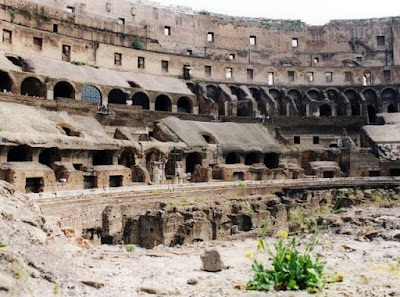
The Colosseum or Coliseum, originally the Flavian Amphitheater
(Latin: Amphitheatrum Flavium, Italian Anfiteatro Flavio or Colosseo)
An elliptical amphitheater in the center of the city of Rome, Italy.
...the largest ever built in the Roman Empire.
It is one of the greatest works of Roman architecture and Roman (social) engineering.
It is one of the greatest works of Roman architecture and Roman (social) engineering.
 The new Yankee Stadium under construction.
Taking a closer look at the Colosseum you realize what a magnificent arena this must have been.
Stand at ground level you can look up at the remains of the most complete side of the structure.
The stands seem so much steeper than modern stadiums, almost vertical, and when full, it must have felt like the crowd would fall on top of you.
It was here that for the first time, sport was widely used as a form of mass entertainment.
The ancient Roman sports may have been very different from the codified spectacles we watch today, but many factors that permeated sport then, still hold true today.
The gladiatorial contests and chariot races that took place were used to occupy the masses, distracting them from what was really happening.
To put on good games was, in a sense, a sign of respect for the people, and a way of winning their trust and affection--a valuable political resource for the future.
As the value of the games as springboards to political success became more and more apparent, competition between public figures to woo the people through spectacle, escalated--leading to ever more lavish and innovative presentations.
This trend delighted many, but also alarmed many. The importance of positions which provided unparalleled opportunities for advancing one’s political career by allowing one to stage the games, led to frequent cases of bribery, as candidates competed fiercely to attain these posts.
The fact that bribery to gain office was a capital offense was only a slight deterrent.
More than this, many clear-thinking Romans came to see the games, themselves, as forms of bribery.
Although the games were, obviously, not considered to be bribery in any strictly legal sense, their impact and use by ambitious politicians could not be discounted by citizens concerned about the future of their democracy.
The growth of the games in Rome was, therefore, not uncontested: philosophers and legislators frequently sought to limit their effect, to prevent them from distorting the political system and from "corrupting the morals of the people."
Moved by these concerns, the government experimented with placing spending caps on the games, as public officials frequently supplemented state funds, with private funds (drawn from their own fortunes, or raised from their political associates), in order to be able to put on ever more spectacular shows.
The clear intent was to prevent individuals from "buying elections" by means of the games.
Along similar lines, there were sometimes efforts to limit the number of gladiators that wealthy sponsors could present. In 65 BC, for example, the massive gladiatorial spectacle that Caesar originally planned was downsized by other politicians.
Although the principal justification was based on security--for the fierce revolt of Spartacus was still on the people’s mind, and the presence of so many well-trained, well-armed gladiator-slaves in the city seemed rather frightening--there was certainly also the motive, brought into play by Caesar’s political opponents, of stunting one avenue by which their rival might gain in political stature.
Interestingly enough, while the gladiatorial games generated some criticism on the basis of their "wasteful extravagance"; their political impact; and the occasional appearance of a free Roman citizen (lowering himself to the level of a criminal or slave in order to obtain glory as a gladiator, at the price of demeaning his class), few humanitarian objections were raised.
Those who lifted their voices against the games on account of their cruelty and brutality appear to have been a rather ineffective minority.
Laws prohibiting Roman nobles of the senatorial and equestrian orders from participating in the games as gladiators, charioteers, and actors were in effect (but they were also frequently violated).
The ruling class feared to present itself on the same level as those it had conquered and enslaved, for these spectacles could show all who watched, the vulnerability of those who sat on top of the social order.
(Long before: Alexander the Great, king of Macedon, was encouraged by his friends to participate in the Olympic Games. They were impressed by his great speed, but he discerned the risk of exposing his mystique and competing against ‘the common man’; and, therefore, is reputed to have said "he would do so only if he might have kings to run with him." Perhaps this spirit is what motivated the Roman legislation.)
Additionally, there were frequent efforts to ban certain components of "the games" in order to prevent the populace from being "corrupted", and the values believed responsible for upholding the greatness of Rome from being undermined.
The theater was a common target of such legislation. In 151 BC a large stone theater nearing completion was, in fact, ordered demolished by the Senate which heeded P. Scipio Nasica’s warning that it was "useless and injurious to public morals."
The content of many of the performances was deemed immoral; lewd; disrespectful; and valueless; there were frequent moments of conflict and discord as factions supporting rival performers clashed; or "rabble-rousers" and protesters descended on the theater to push their political agendas; or as themes or performances seemed to be critical of the ruling class. At various times in Roman history, certain kinds of performances were outlawed, and performers were even banished or executed.
In spite of these dynamics of resistance, however, the Roman games only grew stronger as time went on. In democratic Republican times, the public figures who opposed or limited them lost valuable political capital, and most often ended up sabotaging their political careers, exposing themselves to defeat in the next election; in Imperial times, the Emperors recognized the crucial social value of the games as outlets for the masses to let off their steam without threatening the system; as distractions of critical importance, and allies in their own survival.
To truly understand the games--before continuing on to the always fascinating, always shocking details of the spectacles--it is necessary to take a closer look at the social history of Rome. It is in this history--in the tense and unresolved relations between the classes--that the true meaning, and perhaps the greatest damage of the games, will be found…
Romans, upon liberating themselves, instituted a new political system, transforming themselves into a Republic (a nation governed by its citizens through their elected representatives).
This withdrawal from kings, after a period of bitter abuse by kings, is reminiscent of the American Revolution and the birth of our own democracy. What is also common between the Roman and American experiences is the limited nature of the original democracy which replaced the kings who had provoked the liberating reaction. Democracy, as it first appeared in Rome, was for the wealthy and the powerful. They wanted freedom from others like themselves, not for others to be free from them.
Ultimately, Rome fell because its rich and poor could never bridge the gap between them; and in the tragedy of its demise, the Games played a major role.
Rome gave in to a system designed to placate everyone, without solving anything. Shallow answers were chosen over deep ones, because deep ones were no longer possible without terrible pain; and it is always easier to send one’s pain into the future--to let others suffer for what one has left undone. In a nutshell, the solution to Rome’s social crisis was one in which the rich would continue to dominate, and the poor, in between social bright spots, would continue to lose their land, and struggle to find employment. No adequate plans or social measures would be put into place to prevent poverty from existing or expanding; rather, the social volatility of poverty would be neutralized by the safety net of the dole--free grain, or "bread"--to be distributed, at state expense, to the poor; and by the presentation of ever more spectacular games and entertainments, meant to distract those who might otherwise have rebelled, to channel anger into the passion of spectatorship, and to hide the wounds of injustice which cut into the lives of the poor beneath the wounds of gladiators, dying for them, as they were dying for the rich.
The Colosseum provided vastly improved settings for the enjoyment of the spectacles, its magnificence provided an illusion of opulence, a kind of part-time wealth, for the poor, the out-of-work, the oppressed, the overcrowded, the miserable and the powerless.
To maintain this system, wealth from outside of the system needed to be brought in, which implied conquest, followed by occupation, tribute, and taxation. But to seize and control this external wealth, which was used to buy off the revolution that the system would otherwise have created through its unremedied faults, also required huge expenses--for the maintenance of gigantic armies, positioned throughout the entire ancient world, was no simple matter.
Tax increases were the logical, if deadly response: tax increases to pay for the grain, the games, the armies.
But of course these taxes only broke the back of the remaining productive sectors, creating even more proletarians, who ended up in Rome, dependent upon free bread, and the pacifying mechanism of the games.
And thus the economic vibrancy and human strength of the Empire began to rot away, as men who might have been virile farmers and citizen-soldiers were disowned, then made too weak to be revolutionaries by a system seemingly designed to enmesh and emasculate them.
Ultimatly the rich did not sufficiently respect or accommodate the poor. An unbridgeable social gap made democracy unworkable. The dictatorship of the Emperors was the result. Although democracy was destroyed, social justice was not implemented. The Emperors did not bridge the gap between the classes; instead, they played the part of the champions of the people while they left the gap intact; they became overseers of a compromise that deterred class war, placating the poor while preserving the benefits of inequality; they bought social peace with free bread and games, paying for it with wealth torn from other lands. A huge and convoluted process, in place of a far simpler, fairer and more efficient one, was thus set into motion to try to preserve the Empire: a system of war, taxation and pillage, avoidance and placation, which was doomed by its own internal clock of moral, spiritual, and material decline to fall victim to the very things it was running from.
Does it take foresight, or merely courage to read the writing on the wall?
The Roman satirist Juvenal wrote, in sad disgust, in the early Imperial era: "The people who have conquered the world now have only two interests--bread and circuses."
PLAY BALL!
Hmmmmm?
What this country needs is either a good 5¢ cigar or the reincarnation of an Illinois “rail-splitter” willing to tell the American people “what up” – “what really up.”
We have for so long now been willing to be entertained rather than informed, that we more or less accept majority opinion, perpetually shaped by ratings obsessed media, at face value.
After 12 months of an endless primary campaign barrage, for instance, most of us believe that a candidate’s preacher – Democrat or Republican – should be a significant factor in how we vote.
We care more about who’s going to be eliminated from this week’s American Idol than the deteriorating quality of our healthcare system. Alternative energy discussion takes a bleacher’s seat to the latest foibles of Lindsay Lohan or Britney Spears.
...and then we wonder why gas is four bucks a gallon!
(soon to be five, then six, then seven...)
We care as much as we always have – we just care about the wrong things: entertainment, as opposed to informed choices; trivia vs. hardcore ideological debate.
It’s Sunday afternoon at the Coliseum folks, and all good fun, but the hordes are crossing the Alps and headed for modern day Rome – better educated, harder working, and willing to sacrifice today for a better tomorrow.
Can it be any wonder that an estimated 1% of America’s wealth migrates into foreign hands every year?
We, as a people, are overweight, poorly educated, overindulged, and imbued with such a sense of self importance on a geopolitical scale, that our allies are dropping like flies.
“Yes we can?” Well, if so, then the “we” is the critical element, not the leader that will be chosen in November.
Let’s get off the couch and shape up – physically, intellectually, and institutionally – and begin to make some informed choices about our future.
Lincoln didn’t say it, but might have agreed, that the worst part about being fooled is fooling yourself, and as a nation, we’ve been doing a pretty good job of that for a long time now.


Wednesday, June 11, 2008
ATTACK of the KILLER TOMATOES
 Confused Consumers Question Tomato Safety
A widespread outbreak of salmonella food poisoning linked to raw tomatoes in the United States is creating confusion and chaos for consumers...
Who woulda thunk???
Monday, May 12, 2008
WKRP Theme Song
Well there goes another good WKRP video pulled from YouTube.
Enjoy the theme song while it's still there.
Wednesday, May 7, 2008
WKRP - Pink Floyd - Dogs
WKRP was one of the earliest shows to use extensively contemporary music by big groups and artists of the time such as Foreigner, Pink Floyd, The Who, The Rolling Stones, Queen, The Eagles, Styx, Supertramp, Elvis Presley, The Kinks, Jerry Lee Lewis, Deep Purple, The Knack, Blondie, KISS, Joe Walsh, Earth, Wind & Fire, The Doors and Talking Heads to name a few.
The songs were often tied into the plot of the episode. Music licensing deals cut at the time of production were for a limited amount of time (approximately ten years). In addition, the show was videotaped rather than filmed because it was cheaper to get the rights to rock songs for a taped show. Once the licenses expired, later syndicated versions of the show did not feature the music as first broadcast, but rather generic "sound-alikes" by studio musicians in order to avoid paying additional royalties.
In some cases (when the music was playing in the background of a dialogue scene), some of the characters' lines had to be redubbed by sound-alike actors. This was evident in all prints of the show issued since the early 1990s, which included its brief late-1990s run on Nick at Nite.
As a result, production on a WKRP DVD was delayed for years because of the expense of procuring music licenses. It was feared that fans would reject edited versions. Sales of first-season DVD sets of Roseanne and The Cosby Show suggested that viewers prefer original, uncut episodes. However, as was done with many other television series, the DVD release of WKRP in Cincinnati - Season One has much of the music replaced by generic substitutes. In addition, some scenes have been cut or truncated and voice overs used to avoid using unlicensed musical content.
WKRP is a Mary Tyler Moore production. MTM Enterprises was an independent production company established in 1969 by Mary Tyler Moore

Sunday, May 4, 2008
Slide Mountain (New York)

Slide Mountain is the highest peak in the Catskills. Located in the Town of Shandaken in Ulster County, in southern New York.
While the 4,180-foot contour is generally accepted as its height, the exact elevation of the summit has never been officially determined by the U.S. Coast and Geodetic Survey, and many informal surveys suggest the mountain may actually top 4,200 feet above sea level.
Like most other Catskill peaks, Slide's summit is gentle and rounded, taking the form of a narrow ridge that rises to a wider bump on its eastern end. From there the mountain slopes down steeply to the col with neighboring Cornell Mountain.
The mountain received its name locally from a landslide in 1819 on its north face near the summit. The scar can still be seen today, and in fact was partially gouged out again by another slide in 1982.
Monday, April 28, 2008
Panther Mountain (New York)
Panther Mountain is one of the Catskill High Peaks, located in the Town of Shandaken in Ulster County, New York. At approximately 3,720 feet in elevation, it is the 18th highest in the range. A combination of factors has led geologists to believe the mountain is on the site of an ancient meteorite impact crater.
Its proximity to Slide Mountain, the highest Catskill peak, the relatively short distance required to climb the mountain from the south and the excellent views available from the mountain and nearby Giant Ledge have made Panther one of the most popular hikes in the range.
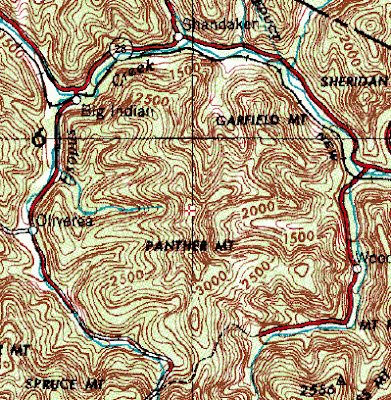 The impact is estimated to have occurred 375 million years ago, during the Devonian period, when much of what is now the Catskills was either river delta or a shallow sea. The crater lies 2,640 feet below the surface, is 6 miles wide, and lies directly under the mountain. The meteorite that struck is believed to have been roughly one-half mile wide, striking with a force equivalent to 11 trillion tons of TNT.
Sunday, April 20, 2008
AARON RUSSO'S AMERICA
Who Is Aaron Russo?
Aaron Russo (February 14, 1943 – August 24, 2007) is (was) an American entertainment businessman, film maker, and libertarian political activist.

Born in Brooklyn into a Sephardic Jewish family originally from Italy, Russo was raised on Long Island. He began promoting rock and roll shows at local theaters while still a high school student. He then worked for his family's undergarment business.
Five years later the twenty-four-year-old entrepreneur opened his own nightclub in Chicago called the Electric Theater/Kinetic Playground. The club became a driving force in the music business, where Aaron helped create the careers of many legendary performers, such as Led Zeppelin, whom he brought to America for the first time. He also promoted some of the Sixties' most successful rock acts, including The Who, Janis Joplin, The Grateful Dead and Jefferson Airplane.
In 1972, Russo began his seven-year partnership with Bette Midler, who became a superstar during his management of her career. In 1975 he produced the Tony award-winning Clams on the Half-Shell Revue, which starred Bette Midler and Lionel Hampton. At the time it was the most successful ten-week Broadway revue in history, grossing more than $1.8 million. While serving as Midler's manager, Russo created and managed The Manhattan Transfer. Later his roster would include such personalities as David Keith, Frederic Forrest, Susan Sarandon and other notable clients.
When Russo turned to producing feature films, his production of The Rose, introduced Bette Midler to motion picture audiences. Midler received a nomination for the Academy Award for Best Actress. The Rose is considered by many to be the classic rock 'n' roll film. Russo also produced Trading Places, starring Eddie Murphy and Dan Aykroyd, which has become a Christmas classic, and Teachers, starring Nick Nolte, Morgan Freeman, and Ralph Macchio.
Russo received numerous awards for his achievements. They include a Grammy, a Tony, an Emmy (for producing the best television special of 1977, Ol' Red Hair is Back, starring Bette Midler, Dustin Hoffman, and Emmett Kelly), plus many gold and platinum records. His films were nominated for six Academy Awards, as well as seven Golden Globes. His films have won three Golden Globes, as well as the Image Award.
In the 1990s he ran into trouble with the Internal Revenue Service (IRS) and eventually found himself with $2 million dollars in liens against him. Years later in 2005, he wrote, produced, and directed a feature film/documentary titled America: Freedom to Fascism, billed as an exposé of the IRS. He also took to describing himself as a "freedom fighter."
Russo made his first run for political office in 1998, when he ran in the Republican party primary for the governor of Nevada. He came in second in the primary, winning 25.9% of the vote in a four-way race. He then endorsed the Democratic candidate, Las Vegas mayor, Jan Laverty Jones, who lost to Republican Kenny Guinn. Russo then joined the Libertarian Party in 1999, saying it was his "true political home." In 2000, he delivered a fiery speech at the Libertarian National Convention, calling Libertarians the "last, best hope for freedom in America." Russo subsequently planned to run for governor in 2002 as a Libertarian, but he was temporarily sidelined by cancer.
In January 2004, Russo announced he was seeking the Libertarian Party's nomination to run for the President of the United States. Russo told LP News (February 2004) he was running because the United States is "heading to totalitarianism. I have a sincere belief [in] the Constitution and Bill of Rights as envisioned by Thomas Jefferson, James Madison, and Ben Franklin. Unfortunately, neither political party respects the vision of our Founding Fathers, and these documents have been relegated to the dustbin. I want to dust them off and restore them to their proper role in our lives." At the Libertarian National Convention in May 2004, Russo received 258 votes, as opposed to 256 for Michael Badnarik and 246 for Gary Nolan, a majority being required to receive the presidential nomination. Russo went on to be defeated on the third and final ballot by nominee Badnarik by a vote of 423-344. While some questioned his style, others argued his media experience would enable him to pose a serious threat to incumbent President George W. Bush, pulling enough votes from otherwise likely Bush voters to affect the outcome in battleground states, in the same way that Ralph Nader was considered to be in relation to Democrat John Kerry.
In 2006, Russo wrote, produced, directed, and starred in a documentary feature film entitled America: From Freedom To Fascism. The film questioned the legality of the income tax and attacked the "growing authoritarianism" in American life. The film was made after Russo had over $2 million of tax liens filed against him by the Internal Revenue Service, the state of California, and the state of New York for unpaid taxes. In an interview with the New York Times, however, Russo refused to discuss the liens, saying they were not relevant to his film.
On January 14, 2007, Russo announced his full support for U.S. Congressman Ron Paul's 2008 presidential bid. Russo also joined the advisory board of Jews for Ron Paul 2008.
In a 2006 interview with Alex Jones, Russo discusses his tax lawsuit and makes a number of claims about Nicholas Rockefeller. Russo talks about a friendship with Rockefeller that began during Russo's 1999 gubernatorial campaign, that led to an invitation to join the Council on Foreign Relations and revelations about a forthcoming New World Order, including an imminent "event" as a pretext for war in the Middle East and a North American Union with a single currency, among others. He stated he was told this by Nicholas Rockefeller "eleven months before 9/11 ever happened".
Russo died of bladder cancer at Cedars-Sinai Medical Center in Los Angeles, California on August 24, 2007, at age 64, following a six year battle with the disease. Russo said his goal was to "try and get the word out to the public about what's happening to America -- and give them an opportunity to try to change things." For an epitaph on his headstone after his death, he told the Las Vegas Sun (November 4, 1999), "I want it to say, 'Freedom Fighter.' "
Downloadable audio interview here!
Buy the DVD here!
Buy the DVD here!
....................
In 1994, Russo created a one-hour, politically themed TV show entitled Aaron Russo's Mad as Hell. The program, part stand-up comedy monologue and part slash-and-burn political rant, offered Russo's views where he criticized NAFTA, The War on Drugs, the concept of a National Identity Card, IRS, Social Security, and the federal budget. When he was unable to find a syndicator for the show, Russo sold it as a video.
Watch the video here!
Mad As Hell!
Buy the DVD here!
Monday, April 14, 2008
The "T" Word
 Click above to read THE HOAX online.
Click above to read this previously BANNED BOOK For FREE!
The Federal Mafia by Irwin Schiff, sold for $42 plus shipping.
Now you can download it and read it for FREE.
Note: The entire book is FREE in acrobat format.
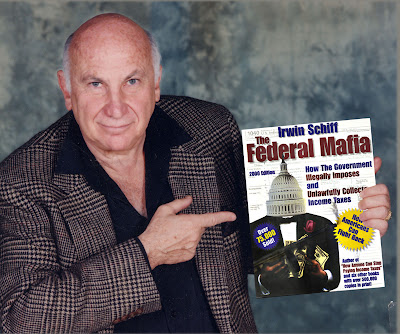 Who is Irwin Schiff???
Irwin A. Schiff is a prominent member of the United States group which refers to itself as the tax honesty movement, and which has been referred to by the Internal Revenue Service and other government agencies as the tax protester movement.
Schiff is known for writing and promoting literature that claims the United States income tax is applied incorrectly.
He has lost several civil cases against the federal government and has a record of multiple convictions for various federal tax crimes.
Schiff is serving a 13-plus year sentence for tax crimes at the Federal Transfer Center at Oklahoma City, Oklahoma.
His projected release date is October 2016.
Irwin Schiff is also the father of controversial stockbroker Peter Schiff, who is credited as a co-author of Irwin Schiff's 1985 book, "The Great Income Tax Hoax: Why You Can Immediately Stop Paying This Illegally Enforced Tax".
The Federal Mafia is a book authored by Schiff, claiming that the income tax system and Internal Revenue Service are illegal.
On August 9, 2004, the Ninth Circuit Court of Appeals upheld an injunction issued by a U.S. District Court in Nevada under 26 U.S.C. § 7408 against Irwin Schiff and associates Cynthia Neun and Lawrence Cohen, against the sale of this book by those persons.
This prohibition does not extend to other sellers of the book. The court rejected Schiff's contention on appeal that the First Amendment protects sales of the book, as the court found that the information it contains is fraudulent.
Schiff, Neun and Cohen are currently barred under the preliminary injunction from selling or advertising material advocating nonpayment of tax, preparing a tax return for others, and from otherwise providing assistance or encouragement to others in violating tax law. Schiff and his associates are additionally required to provide a copy of the injunction to each of their customers, to post it on their website, and to provide the government with a customer list.
Despite Schiff's age (approximately 78 years old), on February 24, 2006, Schiff was sentenced to 151 months (12 years and 7 months) in prison and was ordered to pay over $4.2 million in restitution to the Internal Revenue Service; Schiff was also sentenced to 12 additional months for contempt of court. On December 26, 2007, the United States Court of Appeals for the Ninth Circuit affirmed Schiff's convictions except for the criminal contempt convictions.
Saturday, April 5, 2008
Into Reality
The saddest part...is that he put himself at such extreme risk -- and ultimately died -- only to finally discover basic principles of life he could and should have learned around the dinner table growing up.

McCandless' story isn't really told in the book or the film
http://dwb.adn.com/outdoors/craig_medred/story/9430189p-9342328c.html
CRAIG MEDRED - OUTDOORS
Anchorage Daily News - adn.com
(Published: November 4, 2007)
"Into the Wild'' is a misrepresentation, a sham, a fraud.
There, I've finally said what somebody has needed to say for a long time.
First the book and now the movie try to portray Alexander Supertramp as the Everyman example of youth gone off to the wilderness in search of the meaning of life. Unfortunately, Tramp wasn't Everyman. And he most certainly didn't go off to the wilderness searching for the meaning of life.
No rational individual can overlook the note he left explaining what he was seeking. He went into the wilderness, in his own words, to stage "the climatic battle to kill the false being within.'' Tramp obviously wasn't searching for anything. He was running from something, possibly almost everything.
"No longer to be poisoned by civilization,'' he wrote, "he flees, and walks alone upon the land to become lost in the wild.''
Note the third-person reference to himself there. It's a textbook signal for schizophrenia.
Lost is a good place to be if you suffer from this particular mental illness too. Lost is a place removed from all the outside stimuli that make life horribly, and sometimes dangerously, confusing for a schizophrenic.
Normal people lack the desire to become lost in the wild. Normal people use maps, compasses and GPS devices to avoid becoming lost in the wild.
Over the decades, I've met a lot of the young men who've gone off to the wilderness to search for meaning or, just as often, adventure. They didn't change their names, try to forge new identities or contemplate killing a "false being within.''
A few of them, myself included, did turn their backs on civilization for days, weeks, months or years -- but not because we were fleeing from it. No, we were seeking a world that existed long ago. Some of us still run to that place on a regular basis. It is good to stay in touch with the land. Just as it is good to remind oneself how comfortable and easy it has become to live in the 21st century.
People who change their names and run into the Alaska wilderness to escape have different reasons. Offhand, I can only even think of a few -- "Tramp," aka Chris McCandless, staved to death; Timothy Treadwell, aka Tim Dexter; got eaten by a bear; and Papa Pilgrim, aka Robert Hale, went to jail for incest. Among this trio, Hale at least had a legitimate reason for changing his name. He was fleeing a shady past.
McCandless was emerging from his teen years into early adulthood -- the time adult-onset schizophrenia is known to hit a number of young men -- when he changed his name, ran away from his family and friends and started acting strangely. When Jon Krakauer constructed the myth of Tramp in the book "Into the Wild,'' he tried to portray these behaviors as part of an edgy but normal search for self.
All of that literary claptrap can be summed up in one sentence:
When you abandon your car and burn your money, as McCandless did, you aren't searching for yourself; you've lost yourself.
I feel sorry for Tramp. I feel even more sorry for those who buy the myth of "Into the Wild.''
That Krakauer managed to maneuver his way around Tramp's obvious insanity to mold McCandless into something of a folk hero is a tribute to his skill as a writer. Krakauer took a poor misfortunate prone to paranoia, someone who left a note talking about his desire to kill the "false being within,'' someone who managed to starve to death in a deserted bus not far off the George Parks Highway, and made the guy into a celebrity.
Why the author did that should be obvious. He wanted to write a story that would sell.
There's nothing wrong with that.
Everything is economics, as Karl Marx long ago observed. It's hard to make a living as a writer in America. I admire Krakauer for doing so, and he is a fine writer.
And for all I know, he even managed to convince himself there was truth in the story he was telling. The way he clings to the idea that some poisonous seeds -- or a fungus growing on them -- killed Tramp would make it appear he truly wants to believe death was the fault of misguided food gathering instead of a descent into psychosis.
If only it were so.
Canadian Marc Paterson was among those who made a pilgrimage to Tramp's bus this year.
"Paterson had planned to spend three weeks at the bus, bringing in only a 10-pound bag of rice for food, just as McCandless did in 1992 for his four-month experience,'' wrote Robyn Doolittle of The Toronto Star. "Becoming bored of rice and scared of bears, Paterson lasted three days.''
He gave up on going into the wild and hiked back to the highway.
Why? Because as goofy as he might have been, he wasn't completely crazy.
Study up a bit on schizophrenia, then go read Krakauer's book (which is, by the way, really more about Krakauer than McCandless) and note the signs.
How Sean Penn could have overlooked them when he read the book makes one wonder. But he went a step beyond Krakauer. He dropped Krakauer's soul-searching from the story and made a goofy, sympathetic movie about poor 'Tramp killing himself on that journey to find the meaning of life.
Maybe Penn is as foolish and naive as some of his right-wing critics believe. Maybe he was greedy for money, though he would appear to have all any reasonable person would want.
If you haven't seen the movie, here's a quick plot summary:
The wilderness is wonderful. The city is evil. But don't go to the wilderness because it will kill you.
To which, any smart Alaska tourism promoter will add the caveat -- don't go unless you hire a guide.
My advice would be simpler: Don't go unless you know what you're doing. But that's wasted advice, too, because the people who need it not only won't listen, they are incapable of listening.
That's why, long before Tramp showed up here to die, Johnny Waterman walked off into the vast of Mount McKinley never to be seen again.
A crazed Alaska climber, Waterman walked 180 miles north into the wild from near Anchorage. He struggled through alders and up glaciers to reach the Sheldon Amphitheater. He left a note in the hut there that said only "3/13/81 My Last Kiss. 1:42 p.m." He was last seen wandering up a heavily crevassed route along the Ruth Glacier toward the summit.
His corpse is still out there somewhere waiting to be found.
When it is, maybe someone can write a book and make a movie eulogizing him. He was searching for something too. It's anyone's guess as to what. It's hard enough to figure out what's going on in the human brain when the wiring is working right, but a good writer can always make something up.
Monday, March 31, 2008
Into The Wild - Again!

A Man Made Cold by the Universe
AKA: "I Want to Ride in the Bus Chris Died In"
by Sherry Simpson
We do talk about Christopher McCandless in Alaska. We talk about him a lot. We can't help ourselves. Mostly the discussion is in response to the book, and mostly it is not favorable because of the way McCandless stars as a romantic hero. Krakauer described McCandless as searching for something beyond his privileged but disappointing middle-class existence. "It would be easy to stereotype Christopher McCandless as another boy who felt too much, a loopy young man who read too many books and lacked even a modicum of common sense," Krakauer wrote. "But the stereotype isn't a good fit. McCandless wasn't some feckless slacker, adrift and confused, racked by existential despair. To the contrary: His life hummed with meaning and purpose. But the meaning he wrested from existence lay beyond the comfortable path: McCandless distrusted the value of things that came easily. He demanded much of himself -- more, in the end, than he could deliver."
Many Alaskans take a simpler view. They think the entire meaning of his death was this: he made some dumb-ass decisions, and he died. Others believe he secretly wanted to die, else why would he have made the puzzling choices he did? A few say he was mentally ill; one Anchorage columnist insists that McCandless was clearly schizophrenic. And still others say he died because he was arrogant and prideful, because he didn't honor the power of the land, because he didn't have the humility to observe and ask questions and think.
Nevertheless, because McCandless starved to death in the wilderness -- or what many people conceive of as wilderness -- by some strange transmogrification he has become a culture hero. Web sites preserve high school and college essays analyzing Into the Wild, which is popular on reading lists everywhere and frequently seen in the hands of people touring the state. The Milepost, the most detailed road guide in Alaska, now mentions the site: "If you've read Into the Wild and want to visit the memorial at the bus, locals advise it is a long hike in from the end of Stampede Road and you have to cross the Savage and Teklanika Rivers." A composer named Cindy Cox wrote a piece meant to convey musically the dying man's states of mind -- fear, joy, acceptance, etc. A young outdoorsman I know, Joseph Chambers, says that among his friends a new phrase has emerged: "pulling a McCandless." A person who pulls a McCandless may be trying to test himself or to find himself, Chambers explained, or he may be on a fool's mission, risking his life and causing pain to others while recklessly searching for something that may have been meaningless or stupid all along.
And then there are the pilgrims, the scores and scores of believers who, stooped beneath the weight of their packs and lives, walk that long Stampede Trail to see the place where Christopher McCandless died, and never take a step beyond.
Several visitors mentioned that Into the Wild had prompted their trips, but the book must have motivated nearly all of the pilgrimages, because why else would people attach any significance to the bus?
It was not hard to imagine that before long visitors would be able to buy T-shirts saying, "I Visited The Bus" or "I Survived Going Into the Wild." In fact, so many people seemed to have found their way out here that an espresso stand didn't seem out of the question.
Among my friends and acquaintances, the story of Christopher McCandless makes great after-dinner conversation. Much of the time I agree with the "he had a death wish" camp because I don't know how else to reconcile what we know of his ordeal. Now and then I venture into the "what a dumbshit" territory, tempered by brief alliances with the "he was just another romantic boy on an all-American quest" partisans. Mostly I'm puzzled by the way he's emerged as a hero, a kind of privileged-yet-strangely-dissatisfied-with-his-existence hero.
For many Alaskans, the problem is not necessarily that Christopher McCandless attempted what he did. Most of us came here in search of something, didn't we? Haven't we made our own embarrassing mistakes? But of all the stories in Alaska -- stories about Raven and Koatlekanee and Oddarne Skaldebo and the two girls from Selawik -- this is the one that people buy in airports and read on the way to their Alaskan adventure. This is the one that makes people walk out to the bus, cry a little, and think they've learned something about the north. This is the one that fools people into thinking they understand something about Christopher McCandless and themselves.
We can't afford to take his story seriously because it doesn't say much a careful person doesn't already know about desire and survival. The lessons are so obvious as to be laughable: Look at a map. Take some food. Know where you are. Listen to people who are smarter than you. Be humble. Go on out there -- but it won't mean much unless you come back.
This is what bothers me -- that Christopher McCandless failed so harshly, so sadly, and yet so famously that his death has come to symbolize something admirable. His unwillingness to see Alaska for what it really is has somehow become the story so many people associate with this place, a story so hollow you can almost hear the wind blowing through it. His death was not a brilliant fuck-up. It was not even a terribly original fuck-up. It was just one of the more recent and more pointless fuck-ups.
Read the full essay and more...
"A Man Made Cold by the Universe" originally appeared in The Anchorage Press and is still availabile through the online journal Nidus: A Journal of Contemporary Art and Literature (Spring 2003), in The Alaskan Reader: Voices from the North (2005), and in Travelers' Tales Alaska: True Stories as "I Want to Ride in the Bus Chris Died In" (2003).
Simpson writes with both humor and humility, harnessing great powers of observation of the natural world. In this essay Simpson offers up the (less reverent) Alaskan view of Christopher McCandless, the wanderer who perished in an abandoned bus near Denali, and subject of Into the Wild by Jon Krakauer.
Read this essay and more by Sherry Simpson in "The Accidental Explorer."

Monday, March 24, 2008
Into The Wild

(read the full article here)
Jon Krakauer's haunting account of the meteoric passage of Chris McCandless, the vagabond loner who cut all ties with family and society, plunged into a remote outback, and unwittingly slipped into his own death trap, was headed for the best-seller list. And if Sean Penn had had his way back in 1996, Into the Wild was also headed for the silver screen. Instead, an ill-timed dream that visited McCandless's mother just hours before Penn was to fly to the East Coast to close the deal brought an end to the project.
...
Not every reader of Krakauer's book finds its protagonist as sympathetic as Penn did. In Alaska, especially, the take could be summed up in the chauvinistic formula: One more clueless hippie from the lower 48 screws up in the wilderness and buys the farm. Why glorify him?
...
But Penn, who as a budding star in Hollywood had his own much publicized troubles, was quick to identify with the alienated youth.
...
In the film, McCandless is played by 22-year-old Emile Hirsch, known mainly as a teenage heartthrob in The Girl Next Door and as a pioneering skateboarder in Lords of Dogtown. By turns gallantly romantic and awkwardly shy, jubilant and full of rage, hungry for experience yet saddled with something like a death wish, Hirsch's McCandless is calculated to make the viewer care deeply about this mixed-up young man.
...
Many of McCandless's Alaska critics point out that if the kid had had a map, he probably wouldn't have died. The USGS quadrangle of the wilderness into which he ventured clearly indicates a gauging station with a cable across the Teklanika River, only a mile (two kilometers) downstream from the spot where McCandless, as he tried to hike out, was turned back by the swollen river. The map also locates three cabins in which he might have found emergency rations and supplies. As I read the manuscript of Into the Wild, I voiced the same stricture.
...
Jon, however, had a compelling rejoinder. McCandless's deliberate choice not to take a map, like his choice to carry only a ten-pound (five-kilogram) bag of rice into the wilderness, was, Jon argued, the very kind of upping the ante that we admired in other adventurers. Many landmarks in the history of exploration have come about when bold innovators chose not to use all the means their predecessors had counted on. McCandless's deliberate self-limitation, in this view, was like Reinhold Messner climbing Everest without bottled oxygen, or Børge Ousland skiing across Antarctica without airdropped supplies or prelaid depots.
Stampede Trail
 Take A Closer Look
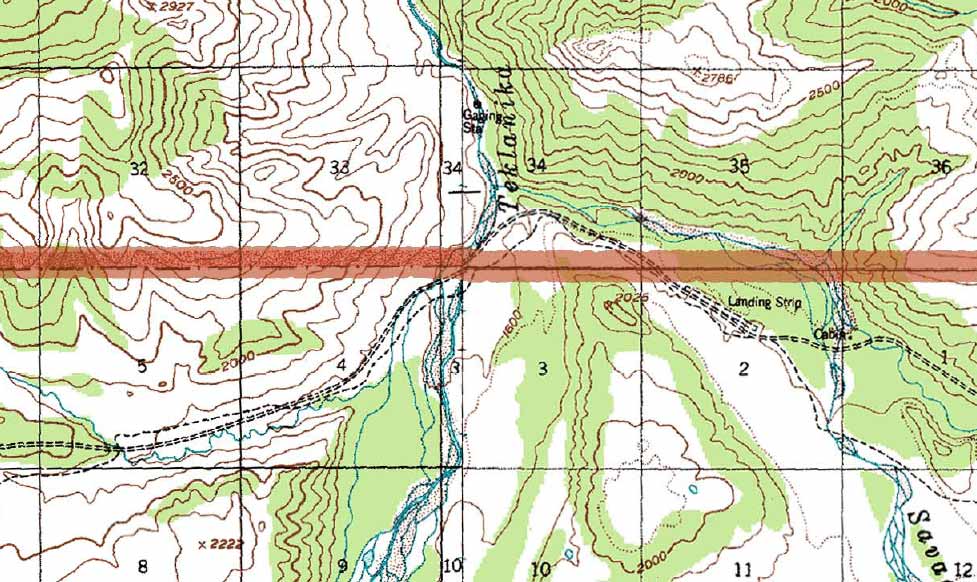 Download Map Here
Visit The Bus
Into the Wild to visit the Bus?
Since the release of Sean Penn's movie "Into the Wild," there have been many more inquiries about the infamous bus on the Stampede Trail.
Please use caution if you are planning to travel to the the bus and dress appropriately. Some of the windows in the bus are broken and there is no way to use the bus to stay warm. Remember, you will be in a backcountry situation.
If you do not know what kind of gear you need or have this equipment to travel safely into the Bush, then you probably have no business trying to do so.
For example:
If you had decided to carry 10 pounds of food with you, a 10 pound bag of rice is probably the wrong choice.
The Alaska bush IS NOT the Cascades or Rockies.
Death is always a possibility.
There are no provisions or supplies at the bus.
Monday, March 17, 2008
"Home" The Movie

NY Daily News
How the pluck of the Irish made NYC their new 'Home'
Monday, March 17th 2008, 4:00 AM Alan Cooke (here on the Brooklyn Bridge) takes the same journey his ancestors did. "Home." Monday night at 9, Ch. 13. Made over three years with very little money, the documentary "Home" examines New York like a cat. It prowls the perimeter, prowls the interior and checks all the angles before it decides that its initial impression was accurate and it's okay to settle down here for a nap. The nominal thread of the film, and the angle that doubtless got it played on WNET/Ch. 13 for St. Patrick's Day, is the emigration of narrator Alan Cooke from Ireland to New York. That journey has a very different tone in this film, obviously, than did the same journey made by some of Cooke's fellow Irish 140 years ago, when "famine ships" brought desperate people whose primary hope was that their children not starve. Cooke starts with much larger dreams. He and Dawn Scibilia, the film's director, see New York as a place of infinite possibility, a city where the whole human experience comes together to lay out a rich palette of cultures that incorporates everything from food to art. "Home" illustrates this point in two primary ways. First, it travels throughout the city and takes its picture from every conceivable angle - across shimmering water, looking into Times Square, crossing a dark, abandoned downtown street in the early morning. It makes New York look as fascinating as the most buoyant immigrant would always have dreamed. At the same time, Scibilia films New Yorkers talking about their town. Woody Allen is a little cryptic, Susan Sarandon is effusive, Pete Hamill talks about how Irish and African cultures came together in the Five Points around 1840 to create tap dancing. Fran Lebowitz is annoyed over gentrification, but hey, at least this answers the question of what happened to Fran Lebowitz. What differentiates this from another attractive filmed homage to New York are the reflections by Cooke and other speakers like Malachy McCourt about what people leave behind to come here. McCourt explains the parts of Ireland that remain with him, like the way of speaking. Cooke speaks about more concrete things, like missing his family and his friends and the land. In the end, that's the real rumination of this film: What exactly is "home"? Scibilla and Cooke never treat that as a black-and-white question. But to the extent it can be a place, they cast a strong vote for New York.
Monday, March 3, 2008
Lunkerville
"If you're too busy to go fishin', then you're just too busy!"

When Indie film director Michael de Avila hooked his passion for story-telling onto his love of bass-fishing, he spawned the award-winning television show, “Lunkerville” (a Rockville Pictures production). Each week, host and co-producer “Mike D” uses his compelling charisma to charm both guest and fish out of the water. While most fishing shows focus on fast-paced pro-tournament competition, Mike D prefers to cast his line at the everyday, recreational bass fisherman, his secret spots and special techniques. In his signature laid-back manner, Mike D reels in the camaraderie, the banter and the bass. And sometimes, his guests even bite back. There’s never a dull moment on “Lunkerville”, the show that catches real people with real fish stories week after week.
“Lunkerville” currently airs in the U.S. and Canada on The World Fishing Network and Water Channel. The shows can also be viewed online at http://www.lunkerville.com/.
Monday, February 25, 2008
Sunday, February 10, 2008
JUNO
 Juno - Script (by Diablo Cody, English)
(PDF Document, 219 KB)
Download
Before her screenwriting debut Juno received a rapturous standing ovation at this year's Toronto Film Festival...(Read more...)
JUNO WRITER DIABLO CODY REVEALS INSPIRATION
Juno writer pens script loosely based on her own high school experience.
Sunday, February 3, 2008
House Of Cards
House Of Cards: The Mortgage Mess
Jan. 27, 2008
Jan. 27, 2008
"Sometimes you have to apply to get a loan, [this time] you almost had to apply not to get one..."
It was all predicated on the idea that real estate prices would keep going up, and up and up, and for a long time they did. But by the summer of 2005, speculators flipping houses in Stockton had helped drive the price of that four-bedroom house to more than $400,000 and the market began to soften, then to tumble.
All of a sudden those subprime borrowers who had taken the free money found themselves upside down, owing more on their new house than it was worth.
...They cannot refinance because the value of the house fell below the existing mortgage. They say they can afford the higher payments but see no point in making them.
Matt: The value of the house keeps going down and the payments keep going up. Where's the logic in that?
Stephanie: Why make a $3200 a month payment on a 1200 square foot home? It makes no sense.
Steve Kroft: But that's what you agreed to do when you bought the house.
Stephanie: Fine if the value was going up. The value is going down.
Steve Kroft: You are saying essentially you are going to stop making payments.
Stephanie: The only advice we've gotten so far is to walk away.
That's exactly the advice that so many "homeowners" will begin to take, as property values plummet.
There is a certain cold logic to just walking away.
Kevin Moran, the real estate agent who gave Kroft the tour of foreclosed houses in the Weston Ranch subdivision, says it is happening every day.
They were never really invested.
Most of the people who lost the houses didn’t lose any money because they never put any money down.
Though their credit is damaged, and they could face legal action in some circumstances, they got to live in a new house for a couple of years, and some of them even managed to get some money with home equity loans or by refinancing.
"Nobody seems to be saying, 'Look, I made a contract with you. I borrowed money from you. I'm gonna do everything I can to pay off that obligation.' People just seem to be saying, 'Look, take the house. Good-bye. I'm leaving,'" Kroft says.
"There was a time, I think, when people felt really bad about not paying off a debt."
"Yeah, I think in those days, loans were made by your local banker or building and loan associations or savings and loan. They were guys you saw in the grocery store. They were on the little league team with you, the PTA, the school. And I think as mortgages became securitized and Wall Street became involved, they became very transactional and there was no relationship built with the borrower and the lender. And I think that makes it easier for someone to see it as an anonymous party at the other end of the transaction and just walk away from it," Moran says.
"Just a business decision," Kroft says.
"A business decision that has to be made," Moran agrees.
"It turns out that if you give people free money, they will take it without really worrying too much about giving it back. Because after all, it was free," Jim Grant says.
Asked if it's a case of greed, Grant says, "Greed, sure. Greed on both sides of the table."
"What do you mean?" Kroft asks.
"Lenders and borrowers," Grant says. "Everyone was gaming the system."
Read more here...

Monday, December 17, 2007

Subscribe to:
Posts (Atom)

