

Saturday, December 12, 2009
Thursday, December 3, 2009
Tiger's Toadies - (real friends or real jerks?)
Q.) What do you call a person who purposefully surrounds themselves with ass-kissers so they can be king?
A.) King of the ass-kissers!
Tiger's 'pals' are toadies
By PHIL MUSHNICK
December 3, 2009
Hiya, kids! Your pal Tiger here again. Ready for your Be A Good Sport Tip of the Day? Today, let's work on our driving:
Say you're out for a spin at 2:25 in the morning and, oopsie, you smash up the car, knock over a lamppost and maybe a mailbox.
Now, when the police ask you to answer a few questions, do what Tiger does: Tell the police to buzz off!
And tell Mom and Dad you want Tiger Woods-signature Nike clothing and equipment for Christmas! Just Do It! Your pal - Tiger.
So what's the cost of good advice that it's too expensive for Tiger Woods? It seems that all he had to do was face the music before it became deafening. Disarm the alarm quickly, honestly, openly: "We're having some marital issues. Things, right now, are not good, but we hope to resolve them, one way or another. I've cooperated with the police in this matter. Thank you."
Chances are that much of what's blowing in would've blown itself out by now. Some of it wouldn't have even caught the wind. "Hey, from the start, he admitted his marriage is on the rocks, didn't he?" Or did Woods & Co. really think that they could keep the lid on a can of half-opened stink? Why, because he's Tiger Woods?
Woods was long ago attached to a climate-controlled, rep-firm-at-work immaculate image. Some recognized it from the start as nauseatingly bogus. It figures that Team Tiger on Saturday came up with a plan to send Woods into a bunker that no sand wedge, even in Tiger Woods' hands, could beat. But hadn't Woods & Co. always gotten its way? This would be just another sweet up and down to save par.
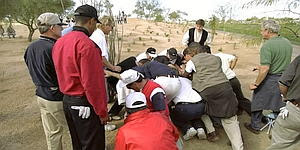
Playing the Phoenix Open in 1999, Woods, starting his third full year as a pro but already identified as extra super special, hit his drive behind a boulder. His approach to the green was blocked. No problem. A dozen spectators teamed to shove that boulder out of his way. A boulder that took 12 men to move was deemed, as per The Rules of Golf, "a loose impediment" -- it was for Tiger Woods.
On TV, that day, and for weeks to come, the announcers thought that boulder-shoving scene was great. Most media did, or so they claimed. So what that such an unnatural advantage wouldn't have been extended to some anonymous schnook who was trying to make a paycheck in that tournament, everyone loves Tiger!
But that was never the point. A few party poopers -- I was one -- didn't see the sport in what had happened. It set a bad example -- for Woods. He didn't have to deal with a boulder that was in his way; boulders are for the other guys to deal with.
I was hoping that Woods would have called the do-gooders off that rock, that he'd have recognized that such use/misuse of the rules is excessive, that it violated the "spirit of the rules" (failed the smell test).
But Woods passed on this golden opportunity to prove that he's a sportsman, that he'd do as everyone else must, that under the circumstances, he'd just have to do the best he could.
Ten years later, that boulder is back. This time, though, he had to deal with it, do the best he could. Unaccustomed to such circumstances, he didn't deal with them very well.
But when you grow accustomed to having it your way, every time, all the time, and you're surrounded by those who either serve that end or established it and maintain it, good advice isn't allowed past the gatehouse.
I've often wondered whether Donald Trump, for all his dough, has a real-deal best friend, the kind who can tell him when he's acting like a jerk and remain his best friend. Or does he surround himself with acolytes he confuses as friends, backslappers who tell him what he wants to hear -- or risk excommunication? I suspect it's the latter.
And I suspect that began to become Woods' reality, too. Woods' "pals" allowed him to think that he could beat this because he's Tiger Woods. A real friend wouldn't have allowed him to think such a foolish thing.
http://www.nypost.com/p/news/national/jerk_pals_are_toadies_lfLSiR6Ryu4HUkRNrmLZPM
Copyright 2009 NYP Holdings, Inc. All rights reserved.


Sunday, November 15, 2009
Who is Rosi Golan?
Rosi Golan is an Israeli born singer songwriter who has made many stops in her travels, including Germany, Paris, and finally ending up in Los Angeles at the age of nine, where she grew up. During her travels, she not only managed to hone her infectiously melodic songwriting, but also learned to speak three languages fluently: French, Hebrew and English.
Rosi Golan is the sensuous voice behind the very popular TV commercial for State Street Global Advisors. You know...the one with the cute dogs and the buried treasure. Have a look.
Many have asked if the song in that commercial is available in it's full length, and for now according to Rosi the answer is...well, no...at least not yet. We need not worry 'bout that anyway, because Rosi is everywhere, and thankfully so. If you would like to hear or download a short uncut version of the Buried Treasure theme song here is the link from the State Street website. Buried Treasure
Buried treasure indeed. For more Rosi, check out her debut CD (2008), The Drifter and the Gypsy. An 11-song record that has already yielded 7 placements on such shows as One Tree Hill (“Come Around”, “Been A Long Day” and “Hazy”), Private Practice (“Lullaby”) and Ghost Whisperer (“Come Around”). Her song “Shine” is the anthem for the international Pantene campaign and “C’est L’amour” is currently licensed to Chicco Clothing with ads in Italy, Portugal and Sweden. You can also look for Rosi in an ad campaign this Christmas from J.C Penny.
Rosi, a Kobalt Music writer, has co-written numerous songs for other artists, including “Let Me Out”, a single from Ben’s Brother debut CD (EMI/Virgin). The song was featured on Grey’s Anatomy and nominated for the prestigious Ivor Novello songwriting award for Best Song.
Rosi has recently toured with William Fitzsimmons (who duets with her on “Hazy”) as well as Greg Laswell, Ari Hest and Jay Nash. She's been featured in Billboard Magazine and Performing Songwriter and her song “Think of Me” was the recipient of the ASCAP’s first Robert Allen Award for songwriting.
Here is the version of HAZY, featuring William Fitzsimmons...
If that doesn't get you, check out this beautifully performed cover.
Bravo! Very well done. I Thank you for that!
::::::::::::::::::::::::::::::::::::::::::::::::::::::::::::::::::::::::::::::::::
Here are the lyrics and chords for Hazy:
HAZY - A song by Rosi Golan
It’s a pretty simple song.
GUITAR - capo 5th fret
INTRO - G-D-Em-C
VERSE - G-Em-C-D...repeat, then...C-D-C-D
REFRAIN - G-D-Em-C 3 times, then at "oh" ...Am-C, then at humming...G-C-G-C
STRUMMING PATTERN - down, up, up, down, up, up, down, up, down
Capo 5
INTRO: G-D-Em-C
VERSE:
G.............Em.......C...............D
I watched you sleeping quietly in my bed
G.............Em................C...................................D
You don’t know this now, but there’s some things that need to be said
C..................D
It’s all that I can hear
C.......................D
It’s more than I can bear
REFRAIN:
G...........D.................Em
What if I fall, and hurt myself?
..........C.................G
Would you know how to fix me?
D................Em
What if I went and lost myself?
......................C
Would you know where to find me?
G...........D..........Em......................C
If I forgot who I am, would you please remind me?
Am..............C
Oh, cause without you things go hazy
G-C-G-C
Humming
Repeats again with the guy singing.
Then with both singing the refrain to end the song.
It’s a very awesome song and great duet song. Enjoy :)
Rosi Golan is the sensuous voice behind the very popular TV commercial for State Street Global Advisors. You know...the one with the cute dogs and the buried treasure. Have a look.
Many have asked if the song in that commercial is available in it's full length, and for now according to Rosi the answer is...well, no...at least not yet. We need not worry 'bout that anyway, because Rosi is everywhere, and thankfully so. If you would like to hear or download a short uncut version of the Buried Treasure theme song here is the link from the State Street website. Buried Treasure
Buried treasure indeed. For more Rosi, check out her debut CD (2008), The Drifter and the Gypsy. An 11-song record that has already yielded 7 placements on such shows as One Tree Hill (“Come Around”, “Been A Long Day” and “Hazy”), Private Practice (“Lullaby”) and Ghost Whisperer (“Come Around”). Her song “Shine” is the anthem for the international Pantene campaign and “C’est L’amour” is currently licensed to Chicco Clothing with ads in Italy, Portugal and Sweden. You can also look for Rosi in an ad campaign this Christmas from J.C Penny.
Rosi, a Kobalt Music writer, has co-written numerous songs for other artists, including “Let Me Out”, a single from Ben’s Brother debut CD (EMI/Virgin). The song was featured on Grey’s Anatomy and nominated for the prestigious Ivor Novello songwriting award for Best Song.
Rosi has recently toured with William Fitzsimmons (who duets with her on “Hazy”) as well as Greg Laswell, Ari Hest and Jay Nash. She's been featured in Billboard Magazine and Performing Songwriter and her song “Think of Me” was the recipient of the ASCAP’s first Robert Allen Award for songwriting.
Here is the version of HAZY, featuring William Fitzsimmons...
If that doesn't get you, check out this beautifully performed cover.
Bravo! Very well done. I Thank you for that!
::::::::::::::::::::::::::::::::::::::::::::::::::::::::::::::::::::::::::::::::::
Here are the lyrics and chords for Hazy:
HAZY - A song by Rosi Golan
It’s a pretty simple song.
GUITAR - capo 5th fret
INTRO - G-D-Em-C
VERSE - G-Em-C-D...repeat, then...C-D-C-D
REFRAIN - G-D-Em-C 3 times, then at "oh" ...Am-C, then at humming...G-C-G-C
STRUMMING PATTERN - down, up, up, down, up, up, down, up, down
Capo 5
INTRO: G-D-Em-C
VERSE:
G.............Em.......C...............D
I watched you sleeping quietly in my bed
G.............Em................C...................................D
You don’t know this now, but there’s some things that need to be said
C..................D
It’s all that I can hear
C.......................D
It’s more than I can bear
REFRAIN:
G...........D.................Em
What if I fall, and hurt myself?
..........C.................G
Would you know how to fix me?
D................Em
What if I went and lost myself?
......................C
Would you know where to find me?
G...........D..........Em......................C
If I forgot who I am, would you please remind me?
Am..............C
Oh, cause without you things go hazy
G-C-G-C
Humming
Repeats again with the guy singing.
Then with both singing the refrain to end the song.
It’s a very awesome song and great duet song. Enjoy :)
Sunday, November 1, 2009
COCA-COLA: THE REAL STORY BEHIND THE REAL THING

A CNBC Original, "COCA-COLA: THE REAL STORY BEHIND THE REAL THING" will premiere on Wednesday, November 11th at 9PM. It will re-air that night at 10PM, 12AM and 1AM. (ALL TIMES ARE ET)
The show will also repeat on the following dates:
Thursday, November 12th at 8PM
Sunday, November 15th at 10PM
ABOUT THE SHOW
With unprecedented access, CNBC pulls back the curtain on Coca-Cola, the most recognizable brand on the planet. In an original one-hour documentary, "Coca-Cola: The Real Story Behind the Real Thing," CNBC's Melissa Lee reveals never-before-seen labs, secret archives and high-tech product testing. Cameras follow Coke's urgent campaign to reinvent itself after years of losing ground to arch-rival Pepsi in the race to develop new, blockbuster beverages. Meet the men and women whose mission it is to put the buzz back in the bottles and see how Coke gets its drinks into the mouths of people in the farthest corners of the globe. From the production line to "Cola Wars," discover the secret that makes Coke pop.
Coke’s Innovation Lab
People say “yes” to coke more than a billion times each day around the globe. But for Coke, that’s not enough. We visit Coca-Cola’s innovation lab --- a war room where Coke plots how to get you to buy more and buy it more often.
An American Classic
Perhaps no product is more embedded in the history of American culture than Coca-Cola. The classic curvy shape of a bottle of Coke is recognized around the globe. A visit to the company’s archives is a lesson in how powerful marketing can turn something as simple as soda into an icon.
The Pepsi Challenge
In the early 1980’s Coca-Cola began an epic battle with Pepsi. The Pepsi Challenge was all too real. Coke conducted its own taste tests and the order was given to change Coke’s 99-year old formula – resulting in one of the great blunders in American business.
Bottlers
The bottlers do something the Coca-Cola company doesn’t do: make Coca-Cola. Not only do the bottlers make the secret blend of ingredients that give Coke its flavor, but they also distribute the entire line of Coke beverages to retailers.
Sunday, October 18, 2009

Wednesday, October 14, 2009
DOW 10,000: "We suspect the food is tainted..."
The stock rally could have legs after a line of better-than-expected third-quarter earnings reports, but Art Cashin, head of floor operations at UBS, said he isn't yet convinced.
"The banquet looks stupendous, I hear the wine is great," he said. "You guys can party on, but some of us are going to sit on the sideline like wallflowers."
Sunday, October 11, 2009
High Places (((revisited)))
The Birdmen
In the latest craze that has killed several extreme adventurers, men don wing suits, jump off mountain tops and glide at speeds of 140 miles per hour.
60 Minutes' Steve Kroft reports, "Some people call them "birdmen," -- and we first learned about them on the Internet."
Transcript:
To the extent that Holmes and the others ever get nervous, it usually comes at a time that many people might consider one of the most mundane legs of the trip, when the end is in sight.
When asked what the most dangerous part of the jump is, Holmes said, "The most important thing is to open that parachute, you know. Just that moment, when you reach back. And throw the pilot chute out there, which extracts your parachute. That's the most critical thing. I mean, if you don't do that, you're not gonna live through it."
But getting down the mountain, which only takes a minute or so, is just part of the extreme sport. The much longer and arduous part involves scaling the mountains you are going to jump off.
"How long does it take to get up to the ledge where you go from?" Kroft asked.
"This one's about an hour and a half. But, you know, some of 'em are up to four, five, six hours for the big, big mountains around here," Holmes explained.
There are no chairlifts, which explains why Holmes, Julian Boulle, and Tom Erik Heiman are members of such a small and exclusive club. You have to be a skilled climber, an accomplished skydiver and an experienced outdoorsman to even attempt to do this.
"You know, it's that first view, looking over the edge that really hits you. You're like, 'Whoa, cool. This is an amazing spot to fly,'" Holmes said.
"Money can't buy you this experience," Boulle explained. "You've got to have the passion to do your time. If you haven't done the time, you just can't get there. You can't arrive with like $10,000 and buy a wingsuit experience."
"What do you have to know? What kind of skills do you have to have to be able to do what you do?" Kroft asked.
"You need to just have some mountain sense. You know, 'How long am I gonna be? What if something goes wrong? How long is it gonna be until I can get back if the weather comes in?' You need to know yourself. 'How much water do I need to have? Can I realistically walk up this mountain for two hours? Or is that not within my physical capabilities?'" Holmes said.
It looks spontaneous, but the birdmen put together a detailed plan every time they jump.
Full Transcript at CBS.com
(((Older Post)))
(((Base Jumping)))
Sunday, October 4, 2009

Friday, October 2, 2009
Not Your Ordinary Love Story:(

Capitalism: A Love Story is the newly released title of Oscar-winner Michael Moore’s latest documentary feature. In Capitalism, Moore returns to the issue that began his career: the disastrous impact that corporate dominance and out-of-control profit motives have on the lives of Americans and citizens of the world.
Moore has said that this film was made for an audience of one. When asked, what he means by that, Moore answered, "I wanted to scare Obama. I didn't make this for the general audience, I made it for him. I want him to know that we know, and that he is on notice. If he ultimately sides with Wall Street in all of this, my next film will make Fahrenheit look like a Disney movie."
So when all is said and done, I suppose we can look forward to at least one more docudrama from Michael Moore. May I suggest a working title? How 'bout calling it 'OOPS!'.
...............
"The main point Moore wants to make, the thing that drives him craziest, is his notion that capitalism, far from being a system that rewards excellence, is a scheme set up to make a profit on absolutely anything. "
Los Angeles Times
- Kenneth Turan
...............
"No matter what side of the political fence you're on or what you think of Moore as an activist and provocateur, a film that explores the economic meltdown and its historical roots is something most of us can get our heads around."
USA Today
- Claudia Puig
...............
Capitalism: A Love Story
Opened October 2, 2009 -- Runtime:2 hr. 7 min.
Rated R (language)
"The main point Moore wants to make, the thing that drives him craziest, is his notion that capitalism, far from being a system that rewards excellence, is a scheme set up to make a profit on absolutely anything. "
Los Angeles Times
- Kenneth Turan
...............
"No matter what side of the political fence you're on or what you think of Moore as an activist and provocateur, a film that explores the economic meltdown and its historical roots is something most of us can get our heads around."
USA Today
- Claudia Puig
...............
Capitalism: A Love Story
Opened October 2, 2009 -- Runtime:2 hr. 7 min.
Rated R (language)
Tuesday, September 29, 2009
No tears for Polanski: here's my vote

You do the crime, you do the time -- or at least pay the bill.
Roman Polanski said he'd pay to end victim's lawsuit
Then failed to live up to the terms of the agreement
By Harriet Ryan and Joe Mozingo, Los Angeles Times
Roman Polanski agreed to pay the victim in his child-sex case at least $500,000 as part of a civil settlement, but then failed to live up to the terms of the agreement, according to court filings reviewed Friday. The documents leave open the question of whether the fugitive filmmaker has ever paid the money he promised in the confidential 1993 settlement with Samantha Geimer. In 1996, she was still trying to get the funds and even attempted to garnish his pay from movie studios. The deal they hammered out called, in part, for Polanski to pay Geimer $500,000 with interest no later than Oct. 11, 1995, according to filings by her attorney. The deadline came and went with no check from Polanski, her attorneys alleged in court documents. A court ordered a formal judgment against Polanski for the amount plus interest -- just over $600,000. The following year, her attorneys enlisted the Los Angeles County Sheriff's Department in an attempt to garnish money intended for Polanski from movie studios, his agent and the Screen Actors Guild, the records show.
Monday, September 14, 2009
Take A Walk On The Wild Side

The first ever wild card entrant to win the U.S Open, Kim Clijsters celebrates her Grand Slam victory in Times Square -- NYC style.
What A Difference A Day Makes

Kim Clijsters beats Caroline Wozniacki 7-5, 6-3 taking the grand slam title last night at the U.S. Open.
Sunday, September 13, 2009
Serena Williams (2) gets Cl_sters F_cked -- U.S. Open Semifinal Style -- 6-4, 7-5
Talk about foot fault. How 'bout foot in the mouth fault?
Not a lot of love last night in Flushing Meadows as Serena Williams was defeated by her, -- as Ralph Kramden would say -- "Biiiiiig Moooooouth".
Williams lost by default, although it was obvious to all that Kim Clijsters was going to win the match, regardless.
Serena Williams was serving at 5-6, 15-30 in the second set, faulting on her first serve. On her second serve, a line judge called a foot fault, making it a double-fault, which made the score 15-40, putting Kim Clijsters one point from victory. Serena then turns to the line judge yelling, cursing and threatening the judge.
Williams said, “I swear to God I’m [F_cking] going to take this [F_cking] ball and shove it down your [F_cking] throat, you hear that? I swear to God.”
The line judge was called over to the chair umpire, tournament referee Brian Earley and Serena Williams joined them, and was heard defending herself, saying, “Sorry, but there are a lot of people who’ve said way worse. I didn’t say I would kill you. Are you serious? I didn’t say that.”
The decision was made. Serena got a point penalty for a code violation of unsportsmanlike conduct. Kim Clijsters wins by default, overshadowing the fact that she clearly out played Serena, her victory celebration -- only moments away -- was marred because of what had happened.
Tournament referee Brian Earley stated “She was called for a foot fault, and a point later, she said something to a line umpire, and it was reported to the chair, and that resulted in a point penalty, and it just happened that point penalty was match point. It was a code violation for unsportsmanlike conduct.”
It is what it is, -- unsportsmanlike conduct -- okay, unacceptable conduct, but let's face it, after all is said and done, Serena exibits a desired level of excitement to an otherwise blandish sport.
Serena Williams Interview
Saturday, September 12, 2009
THE MODERATOR: Questions, please.
Q. To the best of your knowledge, what did you say to the lineswoman out there?
SERENA WILLIAMS: Well, I said something that I guess they gave me a point penalty. Unfortunately it was on match point.
Q. What did you say?
SERENA WILLIAMS: What did I say? You didn't hear? Oh.
Q. What is your consideration of what the linesperson did? Obviously you had a problem with it.
SERENA WILLIAMS: Well, yeah. Clearly just -- in all year I don't -- I've never been foot faulted, and then suddenly in this tournament they keep calling foot faults.
I'm not saying I don't, but like -- I don't know. You know, I'm not going to sit here and make an excuse. If I foot fault, I did. It was what it was, and that's basically all it was.
Q. Do you think that the lineswoman had any reason to feel threatened? Apparently she says she felt threatened.
SERENA WILLIAMS: She says she felt threatened? She said this to you?
Q. I'm just repeating what has been said that she told the chair umpire.
SERENA WILLIAMS: Well, I've never been in a fight in my whole life, so I don't know why she would have felt threatened.
Q. Is it your impression that the chair umpire called her to get her side of it, or did she volunteer her side of it to the chair umpire?
SERENA WILLIAMS: I don't know. I think she volunteered and went over there and said some things. I don't know. I wasn't there. I was getting ready for the next point.
Q. How devastated are you that a match of this caliber had to end that way?
SERENA WILLIAMS: Well, you know, I'm just clearly not happy, but it was -- I don't know. Like, I mean, obviously I wanted to fight.
I always fight when I'm down and keep going. I planned on hitting a couple of aces, but I guess it didn't work out.
Q. Kim looked absolutely stricken, too.
SERENA WILLIAMS: Well, I don't think she understood maybe. I don't think she actually understood it was a point penalty, which meant that I lost that point, which meant that I lost the match.
So that was kind of the whole thing. And I think maybe the umpire should have said something.
Q. Did you say something to the umpire to be misconstrued as a threat? Did you say something to the linesperson that could be construed as a threat?
SERENA WILLIAMS: No, I didn't threaten. I didn't say -- I don't remember anymore, to be honest. I was in the moment. And, you know, everyone's fighting for every point. It was a really crucial point, 15-30, actually.
And, you know, at that point you just kind of keep going.
Q. Did you realize when the linesperson went to the net and went to the chair umpire that you already had the violation from the first set and that this could mean a point penalty in the end of the match?
SERENA WILLIAMS: No, I didn't think I would get a point penalty. I didn't think about it. So, you know, I've been more positive on the court lately.
You know, today was a tough day. I didn't play my best. I kind of felt like I had more errors today I think than all my matches combined.
And it was just -- it was just really tough for me out there.
Q. What degree do you think this taints defeat?
SERENA WILLIAMS: Well, I don't think it does. I think that Kim played really well, and I think she came out with a really big plan. I think that, you know, the next time we play I'll know a little bit more about her game, what to expect, and, you know, what to do.
Q. Do you regret losing your temper though both after the first set and after the foot fault?
SERENA WILLIAMS: I haven't really thought about it to have any regrets. I try to -- I've done -- you know, I try not to live my life saying, I wish, I wish. But, you know, I was out there and I fought and I tried and I did my best.
Q. To what extent do you think maybe the weather and maybe uncertainty of the matches contributed to you maybe losing your temper?
SERENA WILLIAMS: What? That's like the craziest question I ever heard. Weather make you lose your temper? Usually if it's hot you lose your temper, not when it's cold. Come on.
Q. Did it affect your focus?
SERENA WILLIAMS: No, it didn't necessarily affect my focus. I'm a really, really intense player, and I always have been. I mean, my idol is John McEnroe and Martina Navratilova, so -- and Monica Seles, actually. It's kind of a big mixture.
But I just am a really intense person, and I give 200% in everything I do, whether I'm playing tennis or whether I am doing something else. I just go for it.
Q. You've always prided yourself on being an extremely forthright player, and with us here in the press room. Could you tell us what you said on court, please?
SERENA WILLIAMS: I don't think that's necessary for me to speak about that. I've let it go, and I'm trying to better -- to, you know, to get -- to move on.
Q. On court it was picked up where you said, I would never say such-and-such to you.
SERENA WILLIAMS: Because I think she said I would kill you, and I was like, What? I was like, Wait a minute.
But then I had misheard. She had never said that. So that was just something -- I was like, Whoa. Because I was like, Wait a minute. Let's not -- because I'm not that way. So.
She was like, No, I didn't say that. She said something else. I said, Oh, okay. I get it. And I was totally fine, because at that point I realized I got a point penalty and it was match point.
What can I do? I'm not going to complain. It was what it was.
Q. What did she say you said?
SERENA WILLIAMS: I don't know. Like I said, I wasn't there. I was actually at the baseline preparing my serve, and I think maybe she went to the umpire at that point. Actually I didn't even see her walk over to the umpire, so I have no idea what she did.
Q. Are you surprised what a high level Kim plays after being out of the game for two and a half years? You know her from before.
SERENA WILLIAMS: Yeah, no, I think that -- I mean, I wasn't surprised, because I saw her play I think in Cincinnati, and she played incredible. I thought, wow, you know, this is someone to watch out for.
I think it's really good to have her back on the tour. Maybe we can get together and have some calming lessons.
Q. Kim seemed not to want the match to end that way. What did she say to you when you went up to shake hands?
SERENA WILLIAMS: She said she was sorry, and I was like, it wasn't her fault. It was just a point penalty, just at a bad time, basically.
So I just said, Good luck.
Q. What did Venus have to say for you after the match?
SERENA WILLIAMS: Oh, you know, I don't -- that was between me and V.
Q. Do you feel like others have been more angry in tennis matches and not lost them on a code violation?
SERENA WILLIAMS: Absolutely. You know, I'm not -- I feel like there's been -- you know, I was watching lots of matches just because of all the rain coverage. There have been a lot of things out there, a lot of arguments in the past. And, you know, they unfortunately -- well, fortunately didn't lose the match.
But, you know, I just -- like I said, you know, things always -- I don't know. It's fine. I'm moving on.
Q. How will you look back on this, Serena? How will you look back on this match and the way it ended?
SERENA WILLIAMS: Um, I haven't had a chance to think about it. I feel that I could have played better again. I feel that Kim played an incredible match, and, you know, she definitely came out with a plan. I'm glad I got a chance to play, because now I know what to expect and what to do and what to work on.
I think there's so many things that I can do on the court to actually do better, so that's why I can think about what I can do better and learn from it, which I think is actually exciting.
Q. Just to follow on this, how much of your body language on the court, you know, played a part in her thinking otherwise on what happened out there today?
SERENA WILLIAMS: Honestly, I don't understand your question, and I'm sorry. I just didn't... I couldn't relate to it.
Q. Let me ask the question like this: If you were to do anything different than what happened out on the court, what would you do?
SERENA WILLIAMS: Well, I think I would come to the net a little bit more. I think I didn't play aggressive enough tennis, and I would try not to make any errors. I didn't -- I wasn't at my A game or B game today, so that's what I would do different.
Q. Your book talks so much about how you've learned from different experiences and really advanced your life. Aside from the X and is Os of strokes, what do you think you'll learn from this situation?
SERENA WILLIAMS: Well, I think that I'll learn that, you know, it pays to always play your best and always be your best and always act your best no matter what.
And I think that I'm, you know, I'm young and I feel like in life everyone has to have experience that they take and that they learn from, and I think that's great that I have an opportunity to still be physically fit to go several more years and learn from the past.
I like to learn from the past, live in the present, and not make the same mistakes in the future.
Q. Who actually informed you? Was it the umpire who informed you of the point penalty?
SERENA WILLIAMS: No, it was -- is it -- it was Brian Earley who said I had a point penalty. I was like, Okay, wait. That means the match. And so it was him that informed me.
Q. Do you think it was an unfair decision apart from when it happened?
SERENA WILLIAMS: Um, the system -- the system goes if you have a code violation, then I guess the next one -- well, usually goes warning, then -- I don't know. Whatever.
So I guess I was at the next stage, and I just think it was at a bad time.
Q. You seemed to let go very quickly right after the match. Being the last point, match point, does that have anything to do with if it wasn't the match point you still would have been able to let go of it so quickly? That was pretty impressive when you think about it.
SERENA WILLIAMS: Absolutely. And I appreciate you saying that. But if I -- you know, it was a situation where -- I lost my train of thought. Can you repeat that question?
Q. You were able to let go of the emotions. You're very calm now. It was, Hey, you know, you lost.
SERENA WILLIAMS: I try to be really professional. I think Kim played a wonderful match, and I think I played good, too. I think I could have played better, and I actually feel like I can go home and I can actually do better, which I'm really excited about.
There's someone out there that makes me want to go home and makes me want to work out and makes me want to run and do better. I can't wait to do that. I think that when I was down, you know, what was I -- I'm not the beggar, like, Please, please, let me have another chance, because it was the rules, and I play by the rules.
If I get hit, I say I got hit, you know. I play by the rules. That's what it was.
Q. How do you think Kim is playing in comparison to how she played before she retired?
SERENA WILLIAMS: I, um, live in the moment a little too much. I don't quite remember how she played before she retired, but I think now she's playing incredible. I remember her being a wonderful mover, and she's moving really well now, as well. So I think she's -- I don't know.
Q. Do you think the lineswoman deserves an apology?
SERENA WILLIAMS: An apology for?
Q. From you.
SERENA WILLIAMS: From me?
Q. For the yelling and what you said.
SERENA WILLIAMS: Well, how many people yell at linespeople? So I think, you know, if you look at -- I don't know. All the people that, you know, kind of yell at linespeople, I think it's -- kind of comes sometimes. Players, athletes get frustrated. I don't know how many times I've seen that happen.
Q. How does this compare to seeing the tiebreaker count get lost at Wimbledon?
SERENA WILLIAMS: Well, this is no comparison to that. That was completely absurd. It wasn't Venus at fault at all. This was a point where I had a point penalty just on match point.
Q. If you could say something now to that linesperson, what would you say now that you've calmed down and had a chance to think about what happened?
SERENA WILLIAMS: Well, yeah, I haven't quite thought about that yet, and, you know, maybe I'll see her.
Q. Have you ever had a point penalty before?
SERENA WILLIAMS: Um, I'm not quite sure. Have I, do you think?
I used to have a real temper, and I've gotten a lot better. So I know you don't believe me, but I used to be worse. Yes, yes, indeed.
Q. How many times were you called for a foot fault during this tournament?
SERENA WILLIAMS: A lot. I mean, compared to all year? A lot. I haven't been called for a foot fault all year until I got to New York, so maybe when I come to this tournament I have to step two feet back.
Q. Would you be interested to see if you actually foot faulted?
SERENA WILLIAMS: I'm pretty sure I did. If she called a foot fault, she must have seen a foot fault. I mean, she was doing her job. I'm not going to knock her for not doing her job.
FastScripts by ASAP Sports
http://www.usopen.org/en_US/news/interviews/2009-09-12/200909121252748398140.html
Thursday, September 10, 2009
Welcome Back To Reality...

You know what they say. Believe in one hand, sh!t in the other, and see which one fills up first. I wonder if that can fit on a pair of sneaks.
Build 'em up, tear 'em down. That's the way of the world!
Monday, September 7, 2009
Oudin - Petrova 1-6, 7-6, 6-3

The Cinderella story continues as Melanie Oudin creates magic in Flushing Meadows, New York. Down goes Dementieva. Down goes Sharapova. Down goes Petrova.
America's sweetheart does it again with another three set victory, getting plenty of mileage out of her sneaks, and slamming her way to the quarter finals.
Saturday, September 5, 2009
Oudin - Sharapova 3-6, 6-4, 7-5 (BELIEVE)


Oudin's latest win was the biggest so far: She knocked off three-time Grand Slam champion and former No. 1 Sharapova 3-6, 6-4, 7-5 Saturday to reach the U.S. Open's fourth round.
"I can compete with these top girls," Melanie Oudin said. "And if I believe in myself, and my game, then I can beat them."
She's wearing pink-and-yellow sneakers with the word "BELIEVE" stamped near the heel -- it was her boyfriend's idea -- and that mantra clearly has served Oudin well.
"I just had a blast," said Oudin, who buried her face in a towel and sobbed on the sideline when the match ended.
"I don't even know what to say right now," Oudin said, choking back tears in her post-match interview in Arthur Ashe Stadium. "Thank you so much for cheering for me."
It wasn't all that long ago that Sharapova was the up-and-comer, the 17-year-old who won Wimbledon, then tried to make a cell phone call to Mom right there on Centre Court.
So heed Sharapova's words when she says of Oudin: "I certainly think she has a great future ahead of her."
Thursday, September 3, 2009
Oudin - Dementieva 5-7, 6-4, 6-3

Melanie Oudin, a 5-foot-6, blond 17-year-old from Marietta, Ga., wearing customized yellow and purple sneakers adorned with the word 'believe' has suddenly forced her way into the conversation.
Despite playing with a strained illitibiol band in her left leg, Melanie Oudin pulled off the biggest upset of this U.S. Open by defeating No. 4 seed Elena Dementieva, 5-7, 6-4, 6-3 on a beautiful sun-splashed afternoon in Arthur Ashe Stadium.
Sunday, August 23, 2009

Wednesday, August 19, 2009
"Tell me a story!"

Don Hewitt (December 14, 1922 – August 19, 2009)
The founder and executive producer of 60 Minutes, Don Hewitt died at age 86.
Hewitt wrote in his 2001 memoir Tell Me a Story. "We could make news entertaining, without compromising our integrity."
Saturday, August 15, 2009

Subscribe to:
Posts (Atom)

